 eng
 rus
 deu
 spa
 fra
 ita
 por
 srp
 tur
 ukr
 por
 bos

- Bladder, bowel or both
- Why birth does this
- After a caesarean
- What raises the odds
- How bowel control recovers
- After a severe tear
- What helps
- The first weeks
- Three pelvic floor routines
- Habits that ease bladder leaks
- Bowel care
- When exercises are not enough
- Surgery and future pregnancy
- When to get help
- Seek urgent help
- Book an appointment
- Who to ask
- Sources
- Read next
Leaking after birth is common: around 1 in 3 women who have had a baby leak urine at some point. Urine leakage may get better by itself as the stretched muscles and tissues recover, and that can take up to 6 months.
Between 40% and 50% of women leak urine from week 14 of pregnancy until immediately after birth, so you are in large company. But ‘it may settle’ is a forecast, not a plan. Which leak you have matters more than how common it is, because that decides whether you train, change a few habits, or call someone today.

Bladder, bowel or both
Urine leaking when you laugh, sneeze, cough, lift something heavy or exercise is called stress incontinence, the kind tied to pregnancy and childbirth. You might also pass wind without meaning to. Urinary incontinence can range from a small leak to a complete loss of bladder control.
Urge incontinence feels different: the bladder wall muscle contracts too often, causing a sudden, frequent need to pee. It isn’t specific to childbirth. Triggers include too much alcohol or caffeine, not drinking enough, constipation and urinary tract infections.
Bowel leakage means losing wind or stool.

Why birth does this
Pregnancy loosens the support before labour begins. Hormones stretch the muscles and tissues holding up the bladder, bowel and uterus, while the uterus’s weight presses on the pelvic floor and weakens it. Vaginal birth stretches it further. The pelvic floor stays lengthened for some time, weakening the muscles that control the bladder. After a vaginal birth, the nerves that activate those muscles may also work less well, leaving them feeling weak.
Stress incontinence happens when pressure inside the bladder exceeds the urethra’s ability to stay closed. Weakness or damage in the pelvic floor muscles or urethral sphincter makes this more likely, and childbirth is one cause, particularly vaginal birth rather than a caesarean.
After a caesarean
A caesarean doesn't rule out bladder problems. It can lower the risk of severe incontinence after a first baby, but women who have had three caesareans may be just as likely to develop them as women who gave birth vaginally. The operation avoids labour’s stretch, not pregnancy’s hormonal changes and uterine weight on the pelvic floor.
What raises the odds
Bladder leaks are more likely, though never certain, if you had bladder problems before pregnancy or live with obesity, constipation or a persistent cough. A large baby, a long labour (especially the pushing stage), stitches for a large tear or an episiotomy, and a vacuum or forceps delivery also raise the risk. Each further birth adds to it.
A large Italian study followed women from early pregnancy to a year after birth. It found that bowel leakage was more likely or more severe after an assisted delivery, perineal tears, an episiotomy, a high-risk pregnancy or a heavier baby, and among women with difficult access to health services.
These were links, not proof of cause. The same applies to age and weight: women aged 40 or over had about twice the odds of bowel leakage after birth compared with women aged 16-29, while overweight women had somewhat higher odds and more severe symptoms.
How bowel control recovers
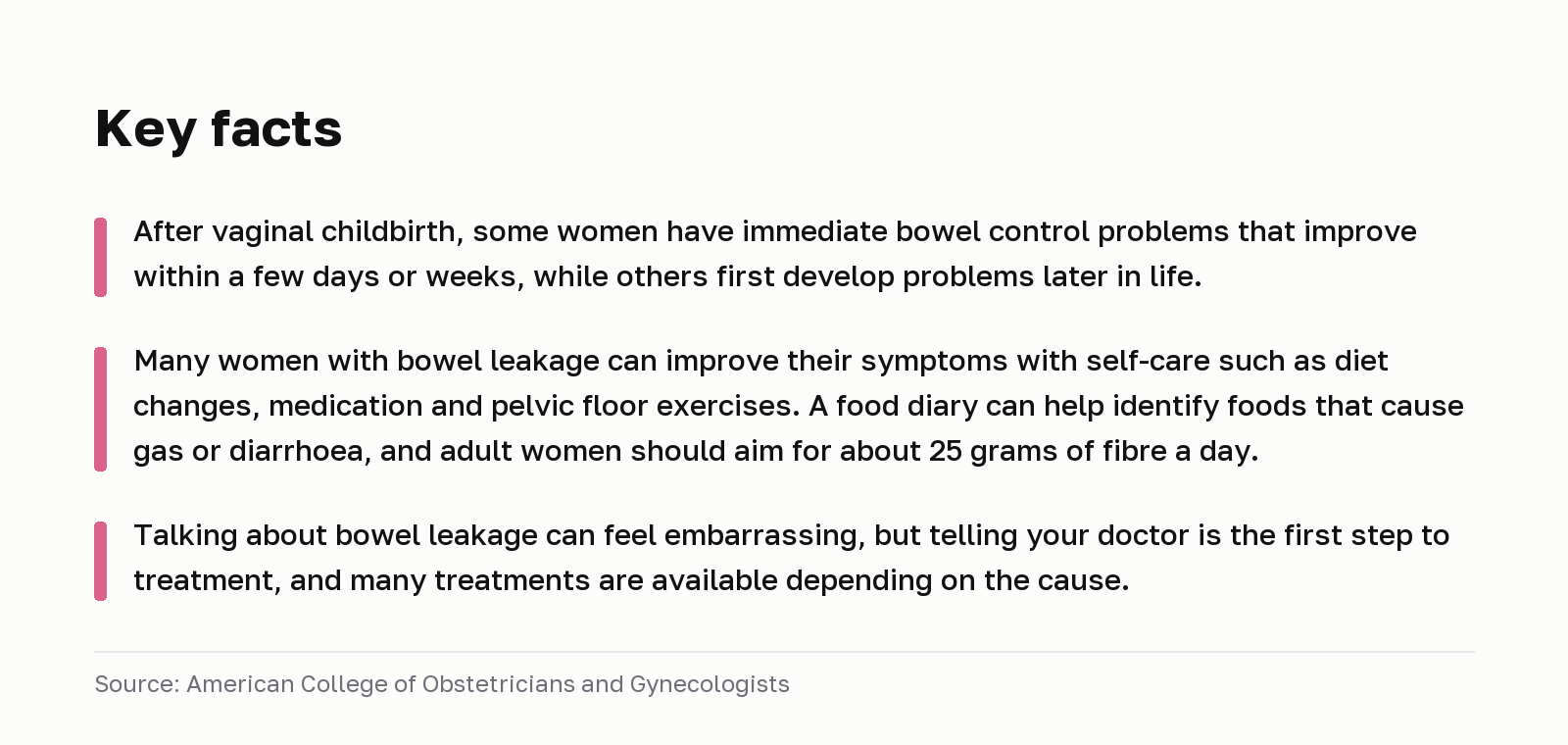
Some women have short-term bowel control problems right after a vaginal birth that improve within a few days or weeks, while others do not develop problems until later in life.
In the Italian study, about 5 or 6 in 100 women reported bowel leakage, wind included, three months after birth. This fell to about 4 in 100 at six months and 3 in 100 at a year. Symptoms were mostly mild.
Among the women in that study who had bowel leakage after birth, about three in four had not had it during pregnancy. Of those affected while pregnant, about 7 in 10 no longer reported it after the birth.
After a severe tear
After a repaired third- or fourth-degree tear has had time to heal, six to eight in 10 women have no long-lasting complications. A small number have trouble controlling their bowels or holding in wind. Specialists can offer physiotherapy or surgery.
What helps
Daily pelvic floor exercises during pregnancy and after birth can help prevent and treat urine leakage. They strengthen the muscles around the bladder, vagina and bottom, which can help stop incontinence and improve prolapse.

The first weeks
Straight after birth, give the pelvic floor time to recover: rest and use ice on the perineal area for the first few days. Then start gentle exercises lying down. Hold for 1 second, rest for 3, and do six repetitions twice a day. Build up to longer holds when you can, with a physiotherapist’s guidance if needed.
After a third- or fourth-degree tear, start pelvic floor exercises as soon as you can after birth, even though the area will not be very strong yet. The exercises strengthen the muscles around the vagina and anus and help healing.
Three pelvic floor routines
In the United Kingdom (UK), the National Health Service (NHS) recommends long squeezes held as long as you can, up to 10 seconds, plus quick squeeze-and-release ones. Build up to 10 of each at least 3 times a day. Breathe normally. Do not pull in your stomach, and exercise after a toilet visit rather than during one.


- Yoga and Pilates after vaginal/cesarean birth
- Cardio and toning
- Morning and evening workouts
- 10–30 minutes a day
- Nutrition and macronutrient program
- Consultations with experts
- Psychological support
- Meditation, SPA and podcasts
Timings vary from country to country, and an Australian version slows the count: pull the muscles around your vagina and anus up and in, as if stopping a wee, and breathe normally. Hold for 8 seconds or as long as you can, relax for 8, and repeat 8-12 times in 3 sessions a day.
A United States (US) routine has you squeeze the muscles you use to stop urine: hold for 3 seconds and relax for 3, repeating 10 times, three times daily. Add 1 second to the hold each week up to 10 seconds. Do not squeeze your stomach, thighs or buttocks, hold your breath, or exercise while you pee.
Choose the routine you will actually do. The timings differ, but the essentials match: the same lift and squeeze, normal breathing, the rest of the body kept out of it, and three sessions a day. Start with the gentle lying-down version if the birth was recent. If counting squeezes is losing you, MomsLab’s pelvic floor sessions go beyond Kegels to breathing and gentle work with the deep muscles, something you could start this week.
Habits that ease bladder leaks
Keeping a healthy weight, eating fibre to prevent constipation, drinking plenty of water, cutting out caffeine and quitting smoking can reduce urine leakage after birth. Avoiding lifting and high-impact exercise can also help, as can going to the toilet when you need to rather than just in case.
Bowel care
Many women with bowel leakage improve with self-care such as diet changes, medication and pelvic floor exercises, depending on the cause and severity. Use a food diary to spot foods that cause gas or diarrhoea. Aim for about 25 grams of fibre a day.
In the Italian study, where pelvic floor training was self-reported and nobody recorded its type or supervision, women who had done it were no less likely to have bowel leakage. Keep doing the exercises. Treat them as one part of bowel care rather than the whole of it.
When exercises are not enough
Structured postnatal rehabilitation combines an assessment, pelvic floor training, biofeedback or electrical stimulation where needed, education and follow-up. Comparative studies, few of which tracked women for long, linked it with bigger strength gains and lower rates of urinary leakage and prolapse than routine care.
Surgery and future pregnancy
If lifestyle changes and pelvic floor exercises do not help, surgery may be an option. One example is a mesh sling placed under the urethra to support the bladder.
In the UK, vaginal mesh (tape) surgery for urinary incontinence may currently not be available on the NHS. Many women have had it without problems, but a few people have experienced serious complications, including long-lasting pain and permanent nerve damage.
The strain of pregnancy and childbirth can sometimes make surgery fail, so if you plan another pregnancy, you may want to wait until you have finished having children.
When to get help
Seek urgent help
Wind or poo coming out through your vagina is not normal and can point to a rare birth injury: a hole between the back passage and the vagina. See a healthcare professional urgently.

Book an appointment
See a doctor if you have a heavy or dragging feeling in your vagina, pain or other problems during sex, pain when you pee, or bladder problems that get in the way of daily life.
A lump in or around your vagina is worth a medical visit too. Pregnancy and childbirth are among the causes of prolapse. Other signs to get checked include heaviness or pressure in your lower tummy or vagina, a bulge you can feel or see, or leaking a little pee when you cough, sneeze or exercise.
You can talk to a doctor or a women’s health physiotherapist whenever you like, and do seek help if bladder leaking continues for more than 6 months after birth. That is the latest point to act, not a reason to wait.
Bowel leakage can feel embarrassing to talk about, but telling your doctor is the first step to treatment. Depending on the cause, many options are available.
Who to ask
You do not have to put up with leaking. In the UK, speak to your midwife or general practitioner (GP) first, and they should advise you to see a pelvic health physiotherapist trained to treat bladder and bowel incontinence. Wherever you live, look for a physiotherapist with that specialist training.
The UK postnatal check, at around 6-8 weeks after birth, is a good time to raise leaking with the GP. Between checks, a GP or health visitor can help at any time and refer you to a specialist.
Put a date in your calendar to ask for help if leaking continues.
Sources
- Acta obstetricia et gynecologica Scandinavica. Fecal incontinence from early pregnancy to 12 months postpartum: A longitudinal cohort study from Tuscany
- American College of Obstetricians and Gynecologists. Accidental Bowel Leakage: ACOG
- Frontiers in public health. Evidence-based translation in postpartum pelvic floor rehabilitation nursing: recent advances and practical integration
- National Health Service (United Kingdom). Pelvic organ prolapse: NHS
- National Health Service (United Kingdom). Surgery and procedures for urinary incontinence: NHS
- National Health Service (United Kingdom). Urinary incontinence: Causes: NHS
- National Health Service (United Kingdom). Your post-pregnancy body: NHS
- Pelvic, Obstetric and Gynaecological Physiotherapy. Bladder and Bowel Incontinence: POGP
- Pregnancy, Birth and Baby (Healthdirect Australia). Bladder weakness (incontinence) after birth: Pregnancy, Birth and Baby
- Royal College of Obstetricians and Gynaecologists. Care of a third- or fourth-degree tear that occurred during childbirth (also known as obstetric anal sphincter injury OASI): RCOG


Download the app and get 7 days free use


