 eng
 rus
 deu
 spa
 fra
 ita
 por
 srp
 tur
 ukr
 por
 bos
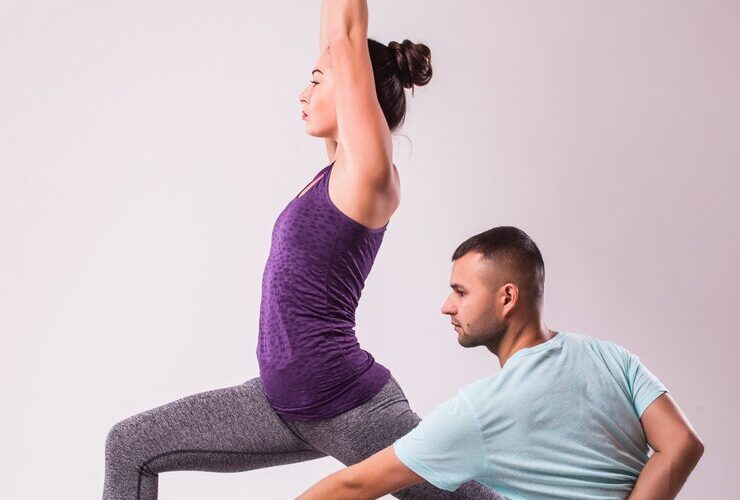
Partner yoga can start with both people seated on the floor. You do not need to lift someone, match their flexibility or perform an acrobatic pose. Choose a person who will listen when you ask to change position or stop.
Agree on contact before you begin
Ask whether touching backs or holding hands feels comfortable. Choose a clear stop word and agree that either person can end a movement without explaining why. These are practical ground rules, not a test of trust or closeness.
If you are both new, take an introductory class. One person having practised yoga before does not make them qualified to teach assisted stretches or lifts. A beginner yoga class should let you ask questions and use alternatives.
Start with a seated back-to-back pose
Sit back to back, keeping your own weight supported by the floor. Settle upright without pushing into each other. If sitting on the floor is uncomfortable, ask the teacher about a stable backless bench. Stay with ordinary breathing, then separate slowly.
This simple seated exercise is described by the US publication Yoga Journal. Its purpose here is to explore comfortable contact, not to reach a deeper stretch. There is no need to hold the position for a set time.


- Yoga and Pilates after vaginal/cesarean birth
- Cardio and toning
- Morning and evening workouts
- 10–30 minutes a day
- Nutrition and macronutrient program
- Consultations with experts
- Psychological support
- Meditation, SPA and podcasts
For the next part of a first session, choose familiar poses side by side rather than adding your partner’s weight. Ask the instructor to demonstrate any assisted variation before trying it. Photographs of double boat poses or paired backbends do not show how to enter and leave them safely.
Keep your own limits
A partner should not pull you farther into a stretch. Stop if a movement hurts, and avoid turning the session into a comparison of who can bend more. The US National Center for Complementary and Integrative Health advises beginners against extreme poses and forceful breathing.
For practice at home, clear enough space for both people to move independently. Plan how to leave each position before starting it.
Pregnancy and recovery change the choice
Tell the instructor about pregnancy, recent birth or an injury. Choose a teacher experienced in adapting yoga for that situation. Being supported by a partner does not make every pose suitable.
After birth, the UK NHS advises a gradual return to exercise and warns against overstretching or twisting too far while joints and ligaments remain more flexible. Yoga with a baby is a separate activity: adult partner poses should not be copied with a child.
Sources
- National Center for Complementary and Integrative Health, United States. Yoga: Effectiveness and Safety
- NHS, United Kingdom. Keeping fit and healthy with a baby
- Yoga Journal, United States. Partner yoga, seated practice


Download the app and get 7 days free use


