 eng
 rus
 deu
 spa
 fra
 ita
 por
 srp
 tur
 ukr
 por
 bos

- Baby blues or postpartum depression?
- What it can feel like
- When to call now, not at the next appointment
- It can begin months after the birth
- What causes it, and who is at risk
- If you have been depressed before
- How it is picked up
- The check before an antidepressant
- Treatment
- Antidepressants and breastfeeding
- Zuranolone, a newer option in the US
- What to put down, and what to pick up
- A year, not a fortnight
- Sources
- Read next
Postpartum depression is a common but serious mood condition that can begin at any time in the first year after giving birth. It is not the baby blues, it is not proof you are bad at this, and it can be treated.
Most of what gets said about it crowds into the first fortnight, around the blues. The window is a whole year, though, and the most useful thing to carry out of pregnancy is this: you can bring it up yourself, at any point, without waiting for someone to ask.

Baby blues or postpartum depression?
Start with the blues. The baby blues typically begin about two to three days after birth and can bring crying for no clear reason, trouble sleeping, eating and making choices, and doubt about whether you can care for a baby; they come and go, and usually get better within a few days or one to two weeks without any treatment.
Feeling down, anxious or irritable for a few days after the birth is very common and usually passes within a fortnight, but that is a description, not a waiting period: if it continues, gets worse or you are struggling to cope, get help.
If sad, hopeless or anxious feelings are more severe than you expected and last longer than two weeks, it may be postpartum depression rather than the blues, and that is the point to get assessed; thoughts of harming yourself are different and need help at once, whatever the date.

What it can feel like
At its core it is sadness or anxiety, only heavier and slower to lift. The part fewer people talk about concerns the baby. Some women with postpartum depression feel disconnected from their baby, as if they are not the baby’s mother, or feel they do not love or care for the baby; this can range from mild to severe, and feeling hopeless after childbirth is not a regular or expected part of being a mother.
If you recognise yourself in that, treat it as a symptom to report, not a secret to keep.

When to call now, not at the next appointment
Thoughts of harming yourself need help at once: contact a health professional now, however long you have felt this way, and tell someone who is with you. Feelings that keep getting worse, or a day you cannot get through, are also reasons to call rather than wait.
If you think you may have postpartum depression, or your partner or family are worried that you do, call your obstetrician or another health professional right away instead of waiting for your postpartum checkup. That advice comes from US guidance and names the clinicians a US reader would call. What carries over anywhere is the timing: now, not at the next visit.
It can begin months after the birth
Among new mothers in 7 US states in 2019, about 7 in 100 screened positive for depressive symptoms on a short two-question screen 9 to 10 months after giving birth, and nearly 3 in 5 of those women had not screened positive at 2 to 6 months.
It catches people out because by then the visitors have gone, a routine has settled, and nobody, you included, is still watching for it. Symptoms at that late point were about 4 times as common in women who had depression before or during pregnancy (prevalence ratio, PR 4.03), a raw comparison in the same survey that shows a link rather than a cause. The public-health conclusion drawn from the US data is that screening throughout the first year can pick up women who felt well in the early months but develop symptoms later.
What causes it, and who is at risk
One explanation is physical and easy to rule in or out, though it accounts for some cases rather than all. Thyroid hormone levels may drop after giving birth, and low thyroid levels can cause symptoms of depression; a simple blood test can show whether that is the cause, and if it is, it can be treated with thyroid medicine.
Four things raise the risk of postpartum depression without making it certain: having had depression before, including before or during pregnancy; a family history of depression; experiencing domestic violence or abuse; and having little support from other people.


- Yoga and Pilates after vaginal/cesarean birth
- Cardio and toning
- Morning and evening workouts
- 10–30 minutes a day
- Nutrition and macronutrient program
- Consultations with experts
- Psychological support
- Meditation, SPA and podcasts
Some research suggests gestational diabetes may increase the risk too, for reasons that are not clearly understood. Anyone can develop depression after having a baby, though, including women with none of these risk factors, so the list is a reason to plan, not a way to rule yourself out.
If you have been depressed before
If you have ever had depression or take an antidepressant, US guidance says to tell your obstetrician early in prenatal care, ideally before pregnancy, because they may suggest starting treatment right after birth to help prevent postpartum depression. If you are already pregnant, that means raising it now rather than later in the pregnancy.
How it is picked up
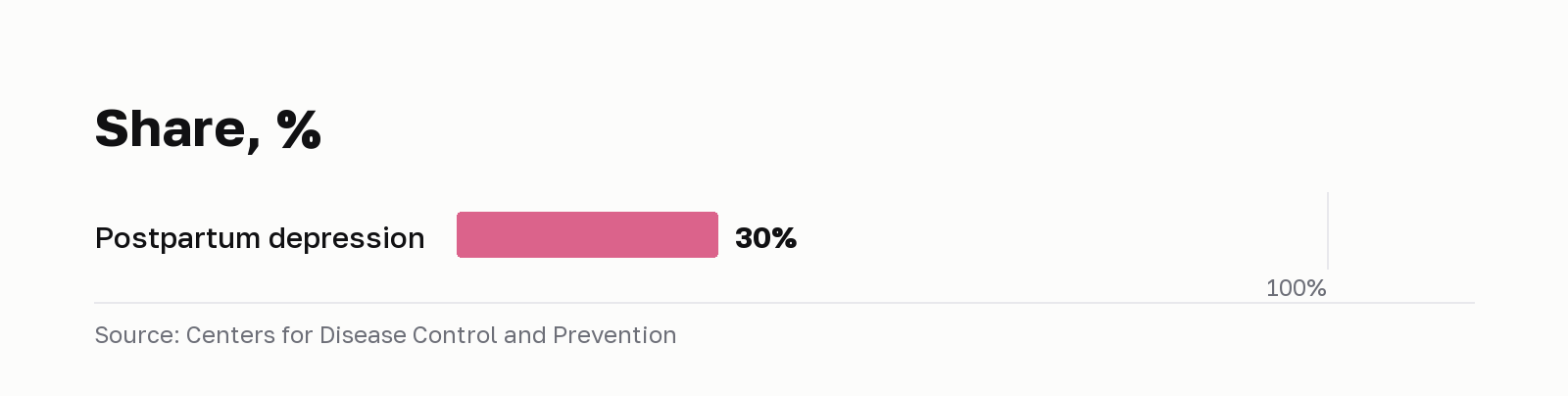
In the US, obstetricians are advised to screen everyone for depression and anxiety with a standard questionnaire at the first prenatal visit, later in pregnancy and at postpartum visits. Even so, about 30% of US women are not asked about symptoms of depression at a prenatal or postpartum checkup, so bring yours up with your doctor even if they do not ask. A questionnaire only works if someone hands it to you, which is why the first move is often yours, wherever you live.
The check before an antidepressant
Under US obstetric guidance, anyone who screens positive for depression should be checked for bipolar disorder before an antidepressant is started, because about 1 in 5 women with a positive screen may have bipolar disorder, a possibility to rule out rather than a diagnosis.
Most people read a positive screen as the answer. For a share that size it might not be, which is why the order of these steps matters.
In bipolar disorder an antidepressant on its own should not be used, because it can worsen mood symptoms and raise the risk of mania, psychosis and suicide; a mood stabiliser is generally used instead. If a prescription is offered and nobody has mentioned bipolar disorder, ask about it.
Treatment
Treatment works, and you are more likely to get better with it than without. The main options are talking therapy and antidepressant medicines, which can be used together, and the choice depends on you and your care team. Postnatal depression, as it is called in the UK, usually gets better in 3 to 6 months, but it can sometimes last much longer, and recovery is more likely with treatment.

Antidepressants and breastfeeding
It may take 3 to 4 weeks of taking an antidepressant before you start to feel better; side effects are mostly temporary, and a different medicine can be tried if they are severe.
Antidepressants pass into breast milk, but generally at very low levels, so taking one while breastfeeding means weighing the benefits of breastfeeding against the possible risk to the baby, a decision to make with your care team. UK guidance puts it more plainly: many antidepressants are safe to use while breastfeeding, and telling your doctor you are breastfeeding lets them prescribe one that suits you. The two point the same way: say you are breastfeeding at the first appointment and choose together, because not every option suits.
Zuranolone, a newer option in the US
Zuranolone is the first medicine approved in the US specifically for postpartum depression in adults, and it is taken by mouth for 14 days. Common side effects of zuranolone include dizziness, tiredness, drowsiness, diarrhoea, cold-like symptoms and urinary tract infections; for 12 hours after each dose you should not drive or do other tasks that need alertness, and while on it you should avoid alcohol, opioids, some antidepressants and some other medicines that act on the nervous system. Go through everything you take with the prescriber.
Use birth control during zuranolone treatment and for one week after the last dose, because the medicine may harm a fetus. Zuranolone passes into breast milk, and its effect on milk supply and breastfed babies is not clear, so some women keep breastfeeding through the 14 days while others pause and resume seven days after the course ends, a choice to make with whoever prescribes it.
What to put down, and what to pick up
Do not use alcohol or illegal drugs to manage symptoms; talking about your feelings to a friend, family member, health professional or support group can help instead. A short, honest conversation counts.
A year, not a fortnight
The first two weeks get the attention, and the blues deserve it. The line that matters runs longer. If something feels wrong at day ten, month four or month ten, that is the time to say it out loud, and you do not need anyone’s permission to be the one who starts.
Sources
- American College of Obstetricians and Gynecologists. Patient Screening: ACOG: College
- American College of Obstetricians and Gynecologists. Postpartum Depression: ACOG
- Centers for Disease Control and Prevention. Gestational Diabetes and Postpartum Depression: Diabetes: CDC
- Centers for Disease Control and Prevention. Timing of Postpartum Depressive Symptoms
- MedlinePlus (National Library of Medicine, National Institutes of Health). Postpartum Depression: MedlinePlus
- National Health Service (United Kingdom). Postnatal depression: NHS
- Office on Women's Health (US Department of Health and Human Services). Postpartum depression


Download the app and get 7 days free use


