 eng
 rus
 deu
 spa
 fra
 ita
 por
 srp
 tur
 ukr
 por
 bos

Trimesters are a rough division: pregnancy is split into three stages of about three months each. Depending on whose guide you read, the first ends at week 12 or 13, the second at week 26, 27 or 28, and the third runs from there until birth.
That spread is not a mistake you have to resolve. The boundaries are conventions that move by a week between guides, and the number your care actually runs on is the week of pregnancy, which starts counting before you were pregnant at all.

Week 1 is your period
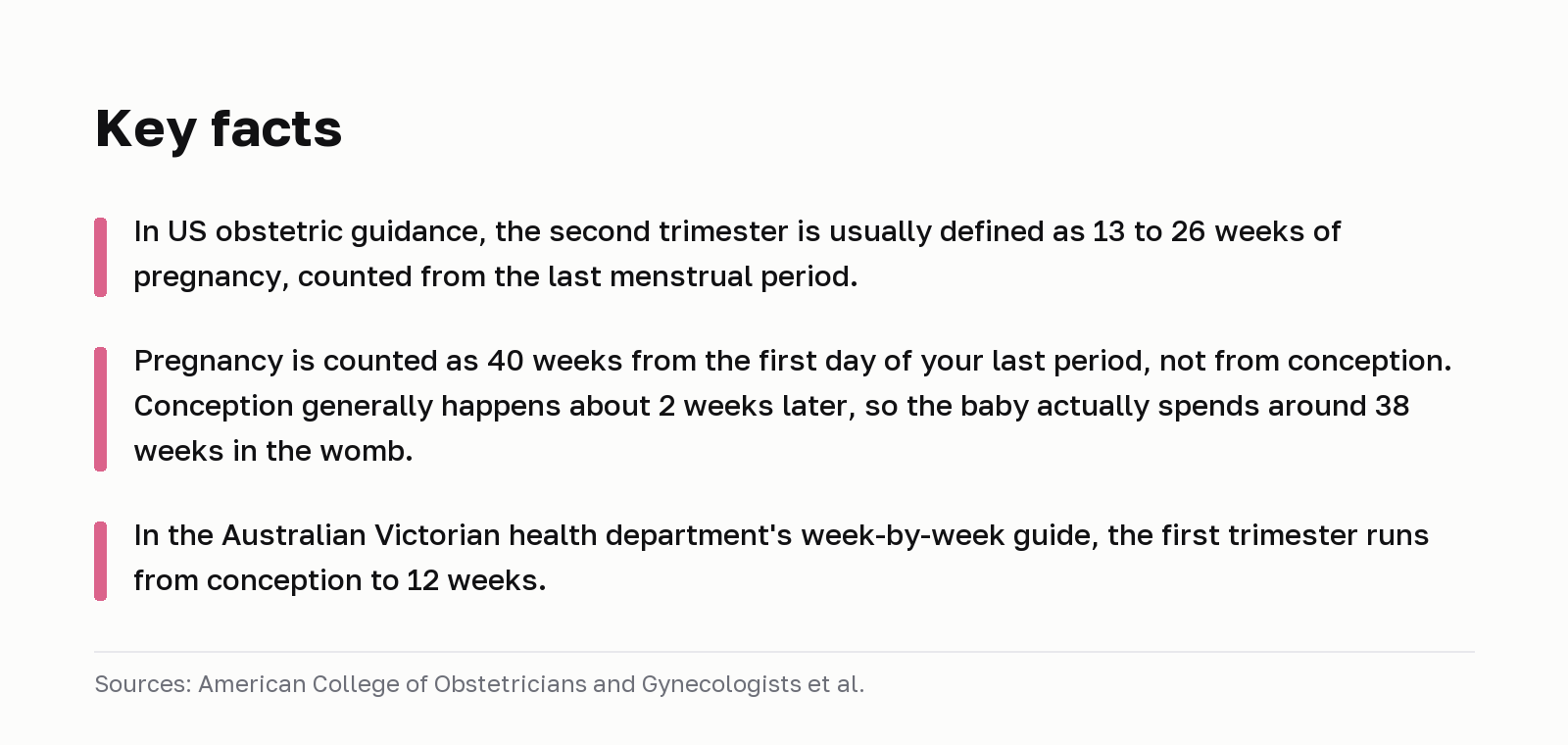
Pregnancy is counted as 40 weeks from the first day of your last period rather than from conception, and because conception generally happens about 2 weeks later, the baby spends around 38 weeks in the womb. The starting point is practical. A period has a date you can write down, while conception rarely does.
Week 1 of pregnancy is your period: it counts toward the 40 weeks even though no baby has been conceived yet, and conception happens near the end of week 2.

First trimester: weeks 1 to 12, or 13
The first trimester runs from conception to 12 weeks, with the weeks counted from the first day of your last period. Some schemes end it a week later, at week 13, and neither count is wrong.

Second trimester: from week 13 to about week 27
In the United States (US), the American College of Obstetricians and Gynecologists (ACOG) usually defines the second trimester as 13 to 26 weeks of pregnancy, counted from the last menstrual period. Victoria’s guide puts the second trimester at 13 to 27 weeks.
Third trimester: week 27 or 28 until birth
The Victorian guide puts the third trimester at 28 to 40 weeks: 40 is the average counted length of a pregnancy, not a fixed end point. Pregnancy length varies between women, and under the same guidance a baby counts as full term if born anywhere between 37 and 42 weeks, so the due date is a guide and some babies arrive prematurely, before that window opens.
One guide, two schemes
The Victorian page that sets the second trimester at weeks 13 to 27 also links to Monash Health hospital pages titled with another scheme: first trimester as weeks 1 to 13, second trimester as weeks 14 to 28, and third trimester as week 29 onwards.


- Yoga for each trimester
- Breathing during labor
- Meditations and relaxation techniques
- Video lectures on childbirth preparation
- Nutrition program
- Consultations with experts
- Helpful articles and books
- Psychological support
Those hospital ranges appear only as page titles, alongside the guide’s own scheme and with no explanation of the one-week shift. Trimesters sort nine months into three chapters: early, middle and late. Being a week either side of a boundary isn’t something you got wrong.
Care follows the week number
In Victorian services, the first-trimester combined screening test, a blood test plus an ultrasound, can be done around week 12, and a morphology ultrasound is offered later, at weeks 18 to 20. Those dates don’t change with the trimester label.
In the US, the Centers for Disease Control and Prevention (CDC) recommends the tetanus, diphtheria and acellular pertussis (Tdap) vaccine, which protects against whooping cough, during weeks 27 through 36 of each pregnancy, preferably earlier in that window, and describes this as getting it early in the third trimester. Victoria’s scheme still counts week 27 as second trimester.
US syphilis treatment guidelines from 2021 also place week 28 in the third trimester: women who live where syphilis is common or who are otherwise at risk during pregnancy are tested twice during that trimester, at 28 weeks and again at delivery.
Counting from conception instead
The CDC’s information for clinicians on radiation in pregnancy gives its risk windows in approximate post-conception weeks, such as the 8th to 15th, rather than counting from the last period. That isn’t the count used for your due date. When a week number comes from a document rather than from your midwife or doctor, check which count it uses before comparing it with your own.
Which line to follow
When guides disagree by a week, follow the week number your own midwife or doctor gives you. Your count doesn’t change with the guide. If a trimester label matters for something specific, such as a vaccine window, ask which scheme they use.

If you want exercise that follows the trimesters without you tracking the boundary, MomsLab’s trimester schedule moves on to the next trimester by itself, with yoga and pilates sessions for each stage that need only a mat and room to lie down.
Sources
- American College of Obstetricians and Gynecologists. Second-Trimester Abortion: ACOG: College
- Better Health Channel (Department of Health, State Government of Victoria). Pregnancy: week by week: Better Health Channel
- Centers for Disease Control and Prevention. Radiation and Pregnancy: Information for Clinicians: Radiation Emergencies: CDC
- Centers for Disease Control and Prevention. Syphilis During Pregnancy: STI Treatment Guidelines
- Centers for Disease Control and Prevention. Tdap Vaccination for Pregnant Women: Whooping Cough: CDC


Download the app and get 7 days free use


