 eng
 rus
 deu
 spa
 fra
 ita
 por
 srp
 tur
 ukr
 por
 bos

- More women feel this than you would guess
- Easing the ordinary kind
- Cramping with bleeding is a different question
- When to call now, not at the next appointment
- Emergency now
- Fever, leaking fluid, heavier bleeding
- Call the same day
- If it starts during exercise
- What else can cause early cramps
- Ectopic pregnancy
- A twisted ovary
- Causes outside the pregnancy
- What a scan can and cannot settle
- When the scan looks fine
- After a miscarriage
- What to keep hold of
- Sources
- Read next
Yes, cramping in the first 3 months of pregnancy is common, and on its own it does not always mean there is a problem. The cramp itself is rarely the useful question, though. What matters is what arrives with it, because the company a cramp keeps is what decides whether you rest tonight or call someone now.

More women feel this than you would guess
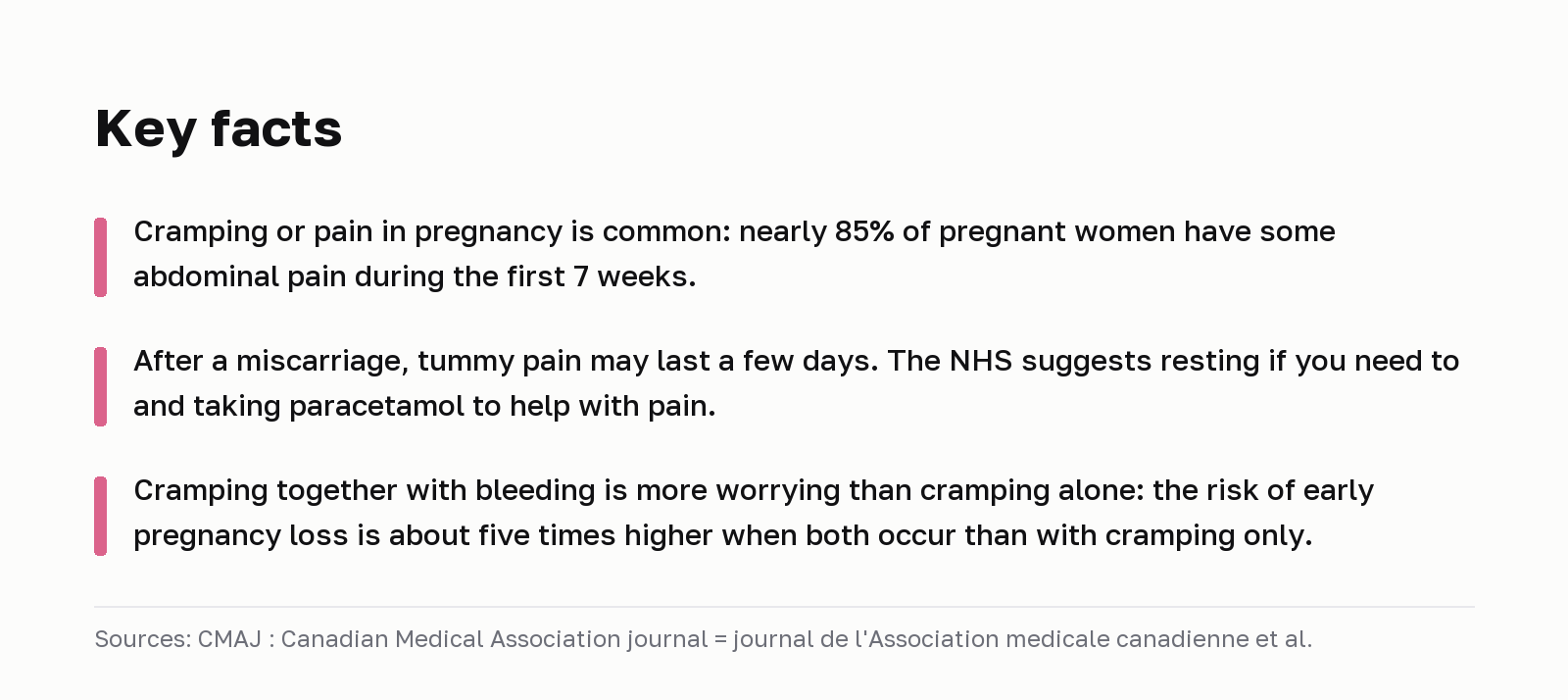
Nearly 85% of pregnant women have some abdominal pain during the first 7 weeks, counting pain from every cause, harmless or not. That is more than 4 in 5, at a stage when many women have not yet told anyone they are expecting, so almost nobody compares notes. It is why an early cramp can feel like a private alarm when it is closer to the norm.
The flip side is just as useful. A symptom that nearly everyone has cannot, by itself, say much about how your own pregnancy is going, so your attention is better spent on the few things that would change the picture.

Easing the ordinary kind
When cramps come and go without bleeding, fever, dizziness or pain that keeps building, the main thing to get right is not frightening yourself into stillness. If you are healthy and your pregnancy is uncomplicated, physical activity does not increase your risk of miscarriage, and it is worth discussing exercise with your doctor at your early prenatal visits. If you want a structure for moving, MomsLab’s trimester schedule keeps the first trimester to gentle strengthening and breathing with no impact, needs only a mat and room to lie down at home, and moves on to the next trimester by itself.

Ask your midwife or doctor before taking any painkiller for cramps while the pregnancy continues, because the paracetamol advice you may come across for miscarriage recovery was written for that situation only.
Cramping with bleeding is a different question
The combination that changes things is cramping with bleeding. In early pregnancy, women who have both face about 5 times the risk of losing the pregnancy that women with cramping alone face (hazard ratio, HR 5.03). Bleeding tends to feel like the frightening part and the cramp like background noise, yet it is the pairing that shifts the risk.
Bleeding or pain in the first 3 months can be a warning sign of a miscarriage or, less commonly, of other early pregnancy complications. Before 24 weeks, the main symptom of a miscarriage is usually vaginal bleeding, sometimes with pain and cramping low in the tummy, and some miscarriages cause no symptoms at all. What you do next depends on what else is happening, and some combinations cannot wait for an appointment.
When to call now, not at the next appointment
British and American health services name much the same warning signs, so if a sign appears on either list, treat it as urgent. The phone numbers given are UK services, because that is where those recommendations were written.
Emergency now
During pregnancy and in the year after delivery, the CDC (Centers for Disease Control and Prevention, the US public health agency) advises seeking medical care right away for belly pain that is sharp, stabbing or cramp-like and does not go away, starts suddenly and is severe, or gets worse over time, or for severe chest, shoulder or back pain.
In the UK, the NHS (National Health Service) says to call 999 if you are pregnant, have vaginal bleeding and any of these: severe tummy pain that stops you doing daily tasks or focusing on TV or a book; pain in your shoulder; feeling sick, faint or dizzy, or losing consciousness; or heavy bleeding that soaks a period pad soon after you put it on.
Also call 999 or go to A&E (accident and emergency) straight away for sharp, sudden, intense tummy pain with feeling very dizzy or fainting, feeling sick or looking very pale: these could mean a fallopian tube has ruptured, which needs surgery as soon as possible.
Fever, leaking fluid, heavier bleeding
A temperature of 38°C (100.4°F) or higher in pregnancy is an urgent warning sign that needs immediate medical care. In pregnancy, seek care immediately too for vaginal bleeding that is more than spotting, like a period, for fluid leaking from the vagina, or for discharge that smells bad.
If you have heavy bleeding, severe pain in your abdomen, pain in your shoulder, dizziness or fainting in early pregnancy, contact your Early Pregnancy Assessment Service or nearest A&E immediately; the RCOG, the UK college of pregnancy doctors, gives the same advice.
Call the same day
For light bleeding or spotting with no tummy pain, or only mild pain that does not stop your daily tasks, or unusual discharge or fluid leaking, the NHS says to get urgent medical help by calling your maternity unit, an early pregnancy unit if you are under 20 weeks, or NHS 111.


- Yoga for each trimester
- Breathing during labor
- Meditations and relaxation techniques
- Video lectures on childbirth preparation
- Nutrition program
- Consultations with experts
- Helpful articles and books
- Psychological support
For any bleeding or pain in the first 3 months, the RCOG advises seeking medical advice from your GP (family doctor) or midwife, an Early Pregnancy Assessment Service or NHS 111, and going to A&E if you are bleeding heavily or your pain is severe.
If you are simply worried and have none of the emergency signs, bleeding and tummy pain in pregnancy can have other causes and are not always serious, and the NHS suggests calling your maternity unit or NHS 111.
If it starts during exercise
While exercising in pregnancy, stop and call your doctor if you have bleeding from the vagina, feel dizzy or faint, have regular painful contractions of the womb, or have fluid gushing or leaking from the vagina, signs that the American College of Obstetricians and Gynecologists lists alongside chest pain, headache, and calf pain or swelling.
What else can cause early cramps
The causes worth knowing by name are the ones that change what you do next.
Ectopic pregnancy
An ectopic pregnancy grows outside the womb, and in the UK about 1 in 90 pregnancies is ectopic. Symptoms, if there are any, usually appear between week 4 and week 12 of pregnancy and can include tummy pain low down on one side, vaginal bleeding or a brown watery discharge, pain in the tip of the shoulder, and discomfort when peeing or pooing. The same set can sometimes come from something else, such as a stomach bug. Even so, the NHS advises contacting your GP or calling NHS 111 if you have a combination of these symptoms and might be pregnant, even without a positive pregnancy test. Worsening abdominal pain, dizziness, bleeding and pain at the tip of the shoulder are the signs that should lead a doctor to rule out an ectopic pregnancy.
A twisted ovary
Ovarian torsion, where an ovary twists, is an emergency that can happen in pregnancy; in one study, more than half of cases in pregnant women were diagnosed in the first trimester, and its symptoms can be mistaken for ordinary pregnancy complaints. The typical sign is sudden pain in one area of the pelvis, often with gut or urinary symptoms, though in pregnancy these signs may be subtle or absent. So sudden pain that settles in one spot is a reason to get checked urgently rather than wait it out.
Causes outside the pregnancy
Appendicitis is the most common surgical emergency in pregnancy that is not caused by the pregnancy itself, and it is one possible cause of pelvic pain. Food poisoning commonly brings stomach pain or cramps with diarrhoea, nausea, vomiting and fever, depending on the germ, and if you are pregnant and have a fever with other flu-like symptoms, see your doctor, because some mild infections can cause problems in pregnancy.
What a scan can and cannot settle
Some causes only show up on a scan. A molar pregnancy, where the placenta is abnormal, is an uncommon cause of early bleeding or pain, affecting about 1 in 700 pregnancies, and it is usually found on an ultrasound scan. If you are assessed at hospital, the scan may be done through the vagina or over the tummy, and neither type of scan increases your risk of miscarriage.

Very early on, the scan may show nothing at all. A pregnancy may not be visible on ultrasound until about 3 weeks after conception, which is at least 5 weeks from your last period; as many as 1 in 5 women whose pregnancy cannot yet be located on a scan may have an ectopic pregnancy, though most do not, which is why a positive test with an empty scan leads to follow-up blood tests and scans.
When the scan looks fine
In the first 3 months, if you have had bleeding or pain but the scan shows the pregnancy progressing normally, this is called a threatened miscarriage, and many women who bleed at this stage go on to have a healthy baby. The name sounds far worse than what it describes. About a quarter of women whose pregnancies turn out normally have some vaginal bleeding in the first trimester.
One rare exception keeps a good scan from being the last word: a pregnancy in the womb and a second one outside it at the same time, estimated at about 1 in 30,000 natural conceptions and up to 1 in 100 pregnancies from assisted reproduction. Because seeing a pregnancy in the womb does not completely rule this out, pain that persists or gets worse after a reassuring scan should still be checked.
After a miscarriage
If you are recovering at home after a miscarriage, tummy pain may last a few days, and the NHS suggests resting if you need to and taking paracetamol to help with the pain. Infection during or after a miscarriage is suspected when there is fever, pelvic pain, a tender womb or pus-like discharge, so tell your doctor or midwife about any of these straight away rather than waiting to see if they pass.
What to keep hold of
A cramp in the first weeks puts you with the majority. The things that change the picture are few and specific, and they are worth knowing well enough to recognise half asleep at 2 a.m. If one of them turns up, you do not need to be certain before you call. Being unsure is exactly what that call is for.
Sources
- American College of Obstetricians and Gynecologists. Exercise During Pregnancy: ACOG
- Centers for Disease Control and Prevention. Food Poisoning Symptoms: Food Safety: CDC
- Centers for Disease Control and Prevention. Urgent Maternal Warning Signs and Symptoms: HEAR HER Campaign: CDC
- CMAJ : Canadian Medical Association journal = journal de l'Association medicale canadienne. Diagnosis and management of early pregnancy loss
- Cureus. Adnexal Torsion of a Luteinized Ovarian Cyst in Early Pregnancy: A Case Report and Literature Review
- Cureus. Spontaneous Isthmic Heterotopic Pregnancy Presenting as Suspected Appendicitis With Successful Term Delivery: A Case Report
- Journal of medical cases. When an Intrauterine Pregnancy Is Not Reassuring: Spontaneous Heterotopic Pregnancy With Tubal Rupture
- National Health Service (United Kingdom). Ectopic pregnancy: NHS
- National Health Service (United Kingdom). Miscarriage: NHS
- Royal College of Obstetricians and Gynaecologists. Bleeding and/or pain in early pregnancy: RCOG


Download the app and get 7 days free use


