 eng
 rus
 deu
 spa
 fra
 ita
 por
 srp
 tur
 ukr
 por
 bos

- Common is not the same as harmless
- Miscarriage in numbers
- Does bleeding always come first?
- Spotting, light bleeding or heavy
- Where the blood comes from
- Ectopic pregnancy, and why it can be quiet
- Two rare cases to mention when you call
- Signs that mean calling now
- Emergency care
- Also right away
- Spotting and nothing else
- If you are in the UK
- At the appointment
- What the result means
- If you are rhesus negative
- Looking after yourself meanwhile
- What to hold on to
- Sources
- Read next
Yes, some spotting is normal very early in pregnancy, but it is still a good idea to tell your doctor or midwife about it. Bleeding of some kind happens in 15-25 of every 100 pregnancies in the first trimester, and in many cases it does not signal a major problem.
The catch is that harmless and serious causes can both start as a few drops, and from home you cannot tell which. So the real question is not whether to call someone, but how fast.

Common is not the same as harmless
Bleeding or cramping in the first 3 months is common and does not always mean there is a problem, but it can be a warning sign of a miscarriage or, less commonly, of other early pregnancy complications, so you should seek medical advice. Bleeding from the vagina in early pregnancy is thought to happen in almost one in four pregnancies, and many of those pregnancies end with a healthy baby.
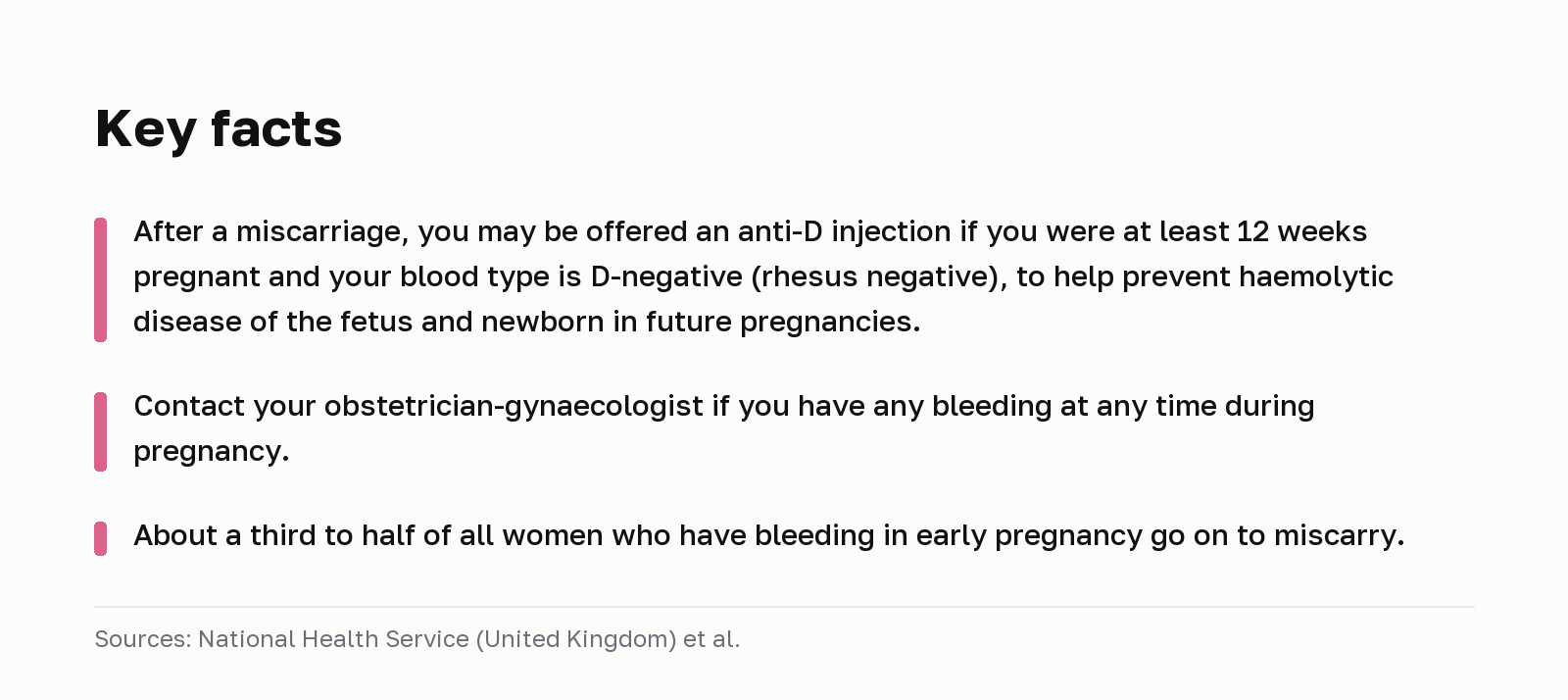
Now the number that reassuring articles tend to skip. About a third to half of women who bleed in early pregnancy go on to miscarry, a figure that counts bleeding of every amount rather than light spotting alone. It stops people because “common” gets heard as “harmless”: many pregnancies with bleeding carry on, and many do not.
Miscarriage in numbers
ACOG, the American College of Obstetricians and Gynecologists, puts miscarriage in the first 13 weeks at about 10 in 100 known pregnancies. The UK’s Royal College of Obstetricians and Gynaecologists (RCOG) says one in five women will have a miscarriage in the first 3 months after a positive pregnancy test, for no apparent reason, and that most miscarriages are a one-off, with a good chance of a successful pregnancy in the future. The figures differ, but neither changes what you do today.
Does bleeding always come first?
Sources also split on whether miscarriage always comes with warning blood. MedlinePlus, a US government health encyclopedia, says almost all women who miscarry in the first trimester have bleeding before the miscarriage. ACOG says bleeding and cramping are signs of early pregnancy loss, but about half of women who miscarry in the first 13 weeks have no bleeding beforehand. Either way, you are bleeding now, so it gets checked.
Spotting, light bleeding or heavy
Once you need a pad, treat it as bleeding rather than spotting. Spotting is a few drops of blood now and then on your underwear, not enough to cover a panty liner, while bleeding is a heavier flow that needs a liner or pad to keep blood from soaking your clothes. The NHS, the UK’s National Health Service, splits it into three: spotting is pink, red or brown spots on your underwear or toilet paper, light bleeding covers larger areas that may need a period pad, and heavy bleeding is red blood that soaks through a period pad, sometimes with clots or lumps, constant or coming and going. Heavy bleeding means getting emergency care now.

Where the blood comes from
Bleeding in early pregnancy can have several causes, including implantation in very early pregnancy, changes to the blood vessels in the cervix that can cause bleeding after sex, a leak of blood from inside the womb, infections such as a urine infection or a sexually transmitted infection, miscarriage, ectopic pregnancy and molar pregnancy. Hormone changes and a threatened miscarriage can cause first-trimester bleeding too, and many threatened miscarriages never become a pregnancy loss; a subchorionic haematoma, a blood clot between the amniotic sac and the wall of the womb, is among the serious causes.
Implantation bleeding usually shows up as light bleeding or spotting around the time your first period after conception would have been due, and often lasts a few days and then stops, though spotting at that point is not automatically implantation.
Ectopic pregnancy, and why it can be quiet
In an ectopic pregnancy the fertilised egg implants outside the uterus, usually in a fallopian tube; it cannot survive and must be removed with medication or surgery, and if the tube ruptures, internal bleeding can cause weakness, fainting, pain, shock or even death. Spotting can be a sign of an ectopic pregnancy, and untreated, one can be life-threatening.
Sometimes vaginal bleeding is the only sign of an ectopic pregnancy; other symptoms can include abdominal, pelvic or shoulder pain, sometimes before you even know you are pregnant, and any of them means calling your doctor right away. That surprises people who picture ectopic pregnancy as sudden, dramatic pain, and it is why painless spotting still earns a same-day call, even though it does not make yours ectopic.
Two rare cases to mention when you call
Very rarely, a pregnancy in the womb and an ectopic pregnancy exist at the same time, even without fertility treatment, so a scan showing a pregnancy in the womb does not fully rule out an ectopic, especially if your pain seems out of proportion to an otherwise reassuring result. If the pain does not fit what you were told, say so.


- Yoga for each trimester
- Breathing during labor
- Meditations and relaxation techniques
- Video lectures on childbirth preparation
- Nutrition program
- Consultations with experts
- Helpful articles and books
- Psychological support
If you have had a caesarean, early bleeding can rarely come from a pregnancy implanted in the scar, which a small case series puts at about 5-6 in every 10,000 pregnancies; it can look like a miscarriage, and mistaking it for one, especially by taking over-the-counter abortion pills without medical supervision, can lead to catastrophic, potentially fatal bleeding. Mention any previous caesarean when you are assessed.
Signs that mean calling now
Spotting alone is a call to make today rather than at your next appointment, and these signs mean right now. The advice comes from three countries and names each one’s services, but it agrees closely, so act on any line that describes you, using the emergency number where you are.
Emergency care
- In the UK, call 999 if you are pregnant and bleeding and have severe tummy pain (you cannot do daily tasks or focus on TV or reading because of it), pain in your shoulder, you feel sick, faint or dizzy or lose consciousness, or the bleeding is heavy, soaking a period pad soon after you put it on.
- In the first 3 months, RCOG advice is to contact your Early Pregnancy Assessment Service or nearest A&E (accident and emergency) department immediately if you have heavy bleeding, severe pain in your abdomen, pain in your shoulder, dizziness or fainting.
- In Australia, Victorian health advice is to go to your nearest hospital emergency department for heavy bleeding, such as soaking two pads an hour or passing clots the size of a golf ball, severe abdominal or shoulder pain, fever or chills, dizziness or fainting, unusual-smelling vaginal discharge, or bleeding in the second half of pregnancy.
Also right away
- In the US, contact or go to your provider right away if you have heavy bleeding, bleeding with pain or cramping, dizziness and bleeding, or pain in your belly or pelvis, and go to the emergency room if you cannot reach them; even if the bleeding stops, you still need to contact your provider so the cause can be found.
- The US CDC (Centers for Disease Control and Prevention) says to seek medical care immediately for any vaginal bleeding in pregnancy that is more than spotting, like a period, fluid leaking from your vagina, or vaginal discharge that smells bad.
- If you have vaginal bleeding in early pregnancy and something other than blood comes out, contact your provider right away.
- Besides bleeding, the NHS lists other signs of miscarriage before 24 weeks: pain and cramping in your lower tummy, pink, grey or white lumps from the vagina that may look or feel stringy, and fluid suddenly coming out of the vagina.
Spotting and nothing else
In US guidance, if an ultrasound has already confirmed a normal pregnancy, you contact your provider on the day you first notice spotting; if you have not had a scan yet, you contact them right away. Before that first scan nobody has seen where the pregnancy is, which is why it changes the timing. ACOG goes further and advises contacting your obstetrician-gynaecologist about any bleeding at any time in pregnancy.
If you are in the UK
In the UK, light bleeding or spotting with no pain, or only mild tummy pain that does not stop your daily tasks, is still a reason to get urgent help: call your maternity unit if you have the number; if you are less than 20 weeks pregnant, an early pregnancy unit may be able to help; and if you have no maternity unit yet or cannot reach an early pregnancy unit, call NHS 111. Those are NHS services; elsewhere, the shared instruction is a same-day call to whoever looks after your pregnancy.
At the appointment
In UK hospitals, an assessment for bleeding or pain in the first 3 months of pregnancy may include a urine pregnancy test, an ultrasound scan (through the vagina, on the abdomen, or occasionally both), an examination of the cervix, a chlamydia test, and blood tests to check your blood group, pregnancy hormone level or both; a vaginal scan may be recommended because it gives a clearer image, and neither type of scan increases your risk of miscarriage.

A home pregnancy test can turn positive just a few days after conception, but a pregnancy may not be visible on ultrasound until about 3 weeks after conception (at least 5 weeks from your last period); if it cannot be seen, UK practice is usually repeat blood tests every 2-3 days to track the pregnancy hormone, and as many as one in five women in that situation may have an ectopic pregnancy, though most do not.
What the result means
If you have had bleeding or pain in the first 3 months but the scan shows the pregnancy progressing normally, this is called a threatened miscarriage; many women who bleed at this stage go on to have a healthy baby, and you may be offered a follow-up scan. In the UK, if that is your result and you have had a miscarriage before, you will be offered progesterone as a vaginal pessary, which can reduce the chance of another miscarriage.
If you are rhesus negative
In US guidance, if your blood type is Rh (rhesus) negative, you will need a medicine called Rho(D) immune globulin to prevent complications in future pregnancies. UK practice after a miscarriage is that if you were at least 12 weeks pregnant and your blood type is D-negative, you may be offered an anti-D injection to help prevent haemolytic disease of the fetus and newborn in future pregnancies. These describe different moments, so if you know you are rhesus negative, say so on the first call.
Looking after yourself meanwhile
There is no specific treatment to prevent a miscarriage, but while you are bleeding it may help to get plenty of rest, use pads rather than tampons, avoid sex until the bleeding has stopped, take mild pain relief such as paracetamol (acetaminophen) if you need it, and report any change to your doctor. Most of the time the treatment for bleeding is rest alongside seeing your provider for tests to find the cause, and you may be advised to take time off work, stay off your feet, not have sex, not douche and skip tampons.

If a miscarriage has already started, it cannot be stopped, and in early pregnancy no emergency care will save the pregnancy once one is under way; you still need to see a doctor, because other causes of bleeding, such as an ectopic pregnancy, need treatment.
What to hold on to
Spotting is common enough that friends will call it probably nothing, and often they will be right. But “probably” cannot be checked from the bathroom floor, and one call can turn it into an answer the same day.
Sources
- American College of Obstetricians and Gynecologists. Bleeding During Pregnancy: ACOG
- Better Health Channel (Department of Health, State Government of Victoria). Pregnancy: bleeding problems: Better Health Channel
- Centers for Disease Control and Prevention. Urgent Maternal Warning Signs and Symptoms: HEAR HER Campaign: CDC
- Cureus. Navigating Outcomes and Tailored Treatment Choices in a Cesarean Scar Ectopic Pregnancy: Insights From Five Cases in a Resource-Limited Facility
- Journal of medical cases. When an Intrauterine Pregnancy Is Not Reassuring: Spontaneous Heterotopic Pregnancy With Tubal Rupture
- MedlinePlus (National Library of Medicine, National Institutes of Health). Vaginal bleeding in early pregnancy: MedlinePlus Medical Encyclopedia
- National Health Service (United Kingdom). Miscarriage: NHS
- National Health Service (United Kingdom). Vaginal bleeding in pregnancy: NHS
- Royal College of Obstetricians and Gynaecologists. Bleeding and/or pain in early pregnancy: RCOG


Download the app and get 7 days free use


