 eng
eng rus
rus deu
deu spa
spa fra
fra ita
ita por
por srp
srp tur
tur ukr
ukr por
por bos
bos
If you were prescribed papaverine suppositories for increased uterine tone and went looking for the guideline behind it, you did not find one because there is not one. International guidance on delaying labour does not name papaverine, does not name suppositories, and does not treat “increased tone” on a scan or an examination as a condition to be medicated at all. What it does address is preterm labour, and the shape of that guidance is worth knowing, because it explains why a prescription meant to be taken for weeks sits so oddly against everything published: the recommended window is measured in hours.

What the 48-hour limit is for
Tocolysis means using medicine to slow or stop contractions. International guidance recommends limiting treatment intended to delay labour to no more than 48 hours for preterm labour, providing time for antenatal corticosteroids to work and for transfer to a hospital that can care for a baby born early. It gives no other duration. The aim is to buy two days for two specific interventions, not to keep the pregnancy going indefinitely.
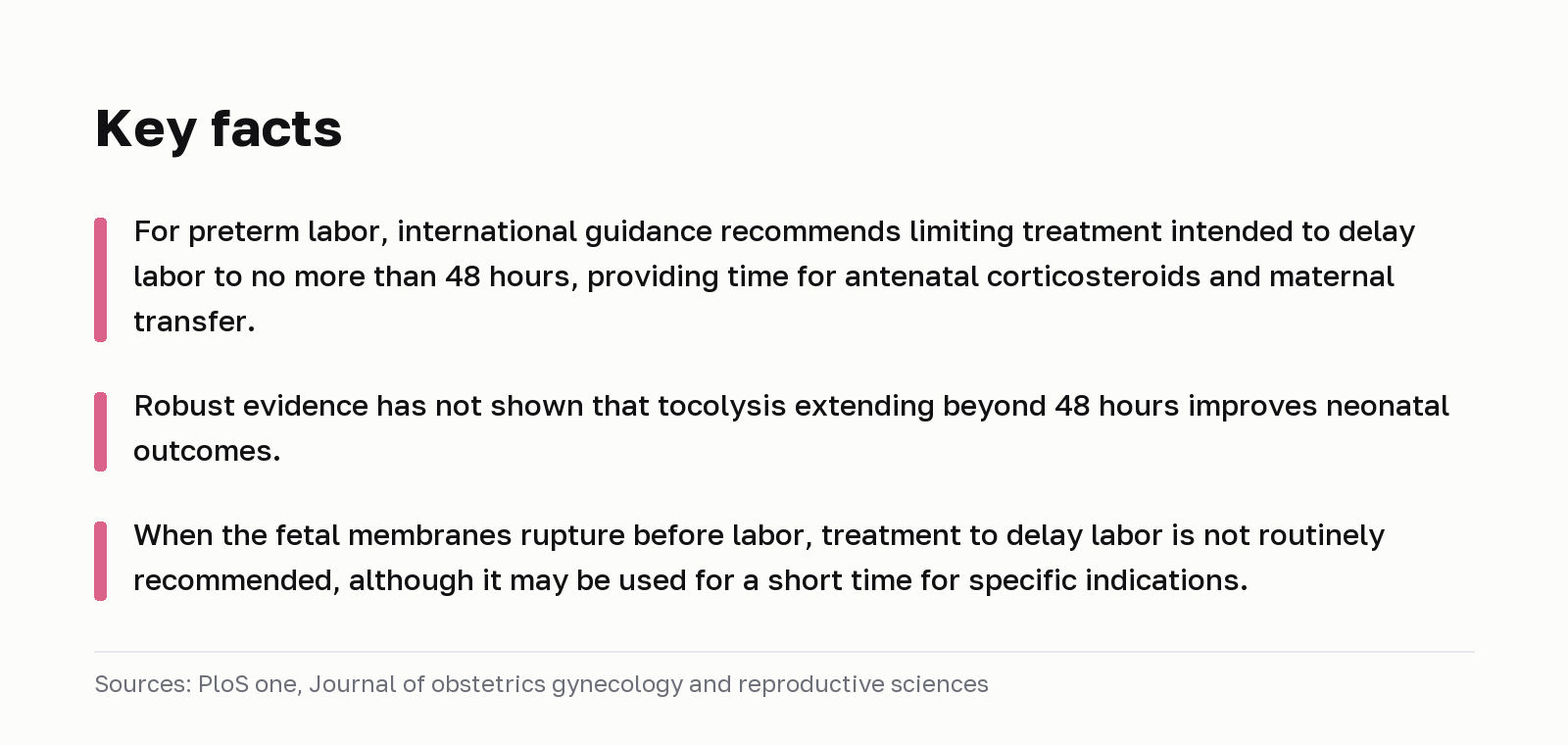
Beyond 48 hours, robust evidence has not shown that continuing treatment to delay preterm labour improves outcomes for newborns. So two days is the limit, and a regimen that runs for a month is a different treatment plan, not a stronger version of the same one.
If your waters have broken
When the fetal membranes rupture before labour, treatment to delay labour is not routinely recommended, although it may be used for a short time for specific indications. If you are offered medicine to hold off contractions after your waters have gone, discuss the reason explicitly with the clinician managing your pregnancy.

“Increased tone” is not the same as preterm labour
A hardening you feel when you stand up from the sofa, a “tense” uterus noted on ultrasound, increased uterine tone and hypertonus are observations. None alone establishes preterm labour. Preterm labour means regular contractions with cervical change before term, assessed by a clinician, and that is what the 48-hour recommendation covers.
Guidance on delaying labour does not cover isolated increased tone, so there is no published duration, recommended medicine or evidence of benefit for that situation. That absence doesn’t justify a long prescription.

Papaverine and local practice
Papaverine is a smooth-muscle relaxant, given in some countries as a rectal suppository. The guidance has not assessed this use and names neither the medicine nor that route, so there is no guideline-backed dose or duration for this prescription.
There is no published evidence base on papaverine suppositories for uterine tone, in either direction. Nobody has produced a figure for how well they work, how they compare to doing nothing or what they do to the pregnancy over weeks.
In every country, local practice moves faster and differently than published recommendations. Papaverine for tone is one place where the two have come apart. That doesn’t mean you were treated badly.
When a prescription has no guideline or trial behind it, the question isn’t whether this is the right drug, but what exactly is being treated and what happens if we watch instead. The clinician who examined you needs to answer that, not a search result.


- Yoga for each trimester
- Breathing during labor
- Meditations and relaxation techniques
- Video lectures on childbirth preparation
- Nutrition program
- Consultations with experts
- Helpful articles and books
- Psychological support
Agree a plan for treatment and daily life
Stopping a prescribed medicine on the strength of an article carries its own risk. Keep taking it and ask the prescriber for the reasoning at the next contact, rather than in three weeks.
Ask three questions. What specifically are we treating: contractions with cervical change or tone seen on a scan? How long is this intended to run? What are we waiting for? If the answer is corticosteroids or a transfer, that matches the 48-hour purpose in the guidance and gives the plan a defined end.
The diagnosis matters beyond medication. Guidance on delaying labour does not tell you what to do on an ordinary Tuesday at 24 weeks when your abdomen feels tight and nobody has diagnosed anything. Agree how much and what kind of daily movement to do with the doctor caring for your pregnancy. Knowing what fits this stage tends to help with the nightly question: “Am I making it worse?”
MomsLab’s trimester schedule moves with you, from gentle strengthening and breathing in the first trimester to easing tension and preparing the pelvis in the second, with yoga and pilates you can do on a mat at home, and it includes video lectures on preparing for birth and a daily meal plan: the trimester schedule.
Using the suppositories
Confirm the route out loud. Papaverine suppositories are given rectally, not vaginally, and confusing the two is the single most common mix-up.

Unwrap the suppository, insert it past the muscle ring and stay lying down for a few minutes so it does not come straight back out. Then wash your hands. A cool suppository holds its shape better than a warm one, so keep the box out of the sun and off the radiator.
Space doses as written on your prescription rather than by feel. If you miss one, take the next at the normal time instead of doubling up.
When to call straight away
Watch for these signs rather than the tightenings themselves. Contact the clinician caring for your pregnancy, or go to the maternity unit, straight away if you notice:
- Regular, painful tightenings that keep coming, particularly before 37 weeks
- A gush or a steady trickle of fluid, or underwear that stays wet
- Any vaginal bleeding
- Constant pain in the abdomen, rather than a tightening that comes and goes
- A change in the baby’s movements, less than usual or nothing for a stretch that is unlike your normal pattern
- Fever, or fluid that smells
- A severe headache with blurred vision or sudden swelling of the face and hands
- Feeling faint, breathless or unwell after taking the medicine
Do not wait for a pattern to establish itself before you ring. A single episode of fluid or bleeding is enough on its own.
Sources
- Journal of obstetrics gynecology and reproductive sciences. Premature Rupture of Fetal Membranes: A Narrative Review Integrating Current Evidence and International Guidelines for Optimal Care
- PloS one. Trends and determinants of acute tocolysis implementation in Japan, 2012-2023: An 11-year nationwide retrospective cohort study


Download the app and get 7 days free use


