 eng
 rus
 deu
 spa
 fra
 ita
 por
 srp
 tur
 ukr
 por
 bos

- Why 28 isn’t a target
- Cycle length and bleeding days
- Keep a record you can trust
- Day 14 is a 28-day number
- When your usual pattern changes
- Pregnancy and illness
- Puberty and the years before menopause
- When a teenager needs a check
- Reasons to book an appointment
- Preparing for the visit
- Sources
- Read next
Anywhere from 21 to 35 days between periods is normal, as long as your cycle is regular. The gap is counted from the first day of one period to the first day of the next, not from the day the bleeding stops, and that detail moves the number more than you might expect.
So the useful question isn’t whether you hit 28. It’s whether your own gap, counted properly, sits inside that range and stays roughly steady from one month to the next.

Why 28 isn’t a target
On average, a period comes around every 28 days. The common interval is 21 to 35 days, which the National Health Service (NHS) in the United Kingdom (UK) counts as normal when the cycle is regular. A steady 33-day cycle fits.
Some research counts cycles of 24 to 38 days as regular, a study definition rather than a clinical guideline, and that band overlaps almost entirely with the NHS one. In one survey, about 95 in 100 of 884 women put their usual cycle, as they recalled it from before they had coronavirus disease (COVID-19), between 24 and 38 days, and about 7 in 10 between 24 and 33. For your own cycle, use 21 to 35.

Cycle length and bleeding days
Day 1 is the first day of your period, when actual bleeding starts. Count up to and including the day before your next period, which begins a new cycle at day 1.
A period itself lasts between 2 and 7 days, usually about 5. Those days count too. Starting when bleeding stops leaves out the time you bled: with a 5-day period, a regular 30-day cycle becomes a 25-day gap. That can make a normal cycle look short.
If one period starts on 3 March and the next on 1 April, 3 March is day 1, 31 March is the last day of that cycle, and the cycle lasts 29 days.
Keep a record you can trust
Tracking periods in an app or diary can help you see whether they’re irregular, and an online period calendar can use past dates to predict when the next one should start.

A record you keep yourself has one blind spot: it can’t distinguish a truly missed period from one you forgot to log. Enter the first day of bleeding on the day it happens, not from memory at the end of the month.
If you're trying to conceive, the MomsLab cycle calendar works from exactly those entries: it shows your cycle phases with a forecast of your next period and fertile window, and the predictions sharpen the longer you keep logging.
Day 14 is a 28-day number
Ovulation is tied to the end of the cycle, not the start. In most women, it happens around 10 to 16 days before the next period, so day 14 is a likely fertile time only in a regular 28-day cycle, not in shorter or longer ones.


- Pelvic floor
- Flat stomach
- Healthy back
- Posture and tone
- Yoga and Pilates
- Personalized menu
- Macronutrients and eating habits
- Meditations and podcasts
In a regular 35-day cycle, those 10 to 16 days before the next period fall about a week later than in a 28-day one. With a 24-day cycle, they come about 4 days earlier.
Ovulation is hard to pinpoint exactly, so counting days gives you a rough guide to your fertile time and is not a method of contraception.
When your usual pattern changes
Periods count as irregular if the gap between them is less than 21 days or more than 35 days. Irregular periods are not usually a sign of a problem, but the NHS advises speaking to a general practitioner (GP) if yours are irregular or your normal pattern changes.
Common causes include puberty, the start of menopause and pregnancy, as well as losing or gaining a lot of weight, stress and anxiety, and exercising too much. Some hormonal contraception can also be responsible, including the progestogen-only pill, the contraceptive injection and the intrauterine system (IUS). Sometimes a condition such as PMOS (formerly called polycystic ovary syndrome, or PCOS) or a thyroid problem is behind it. The appointment helps work out which applies.
Pregnancy and illness
If you miss a period and you’ve had sex, you could be pregnant. The NHS advises seeing a GP if pregnancy tests are negative and you’ve missed 3 periods in a row.
Illness can shift the gap too: almost half of women in one survey reported shorter or longer cycles after a COVID-19 infection, with most changes appearing mild.
Puberty and the years before menopause
Periods are more likely to be irregular when they first start in puberty and when you’re nearing menopause. Menopause typically arrives between the mid-40s and mid-50s. As it approaches, periods don’t usually stop suddenly: they may come less often over a few months or years before stopping altogether.
When a teenager needs a check
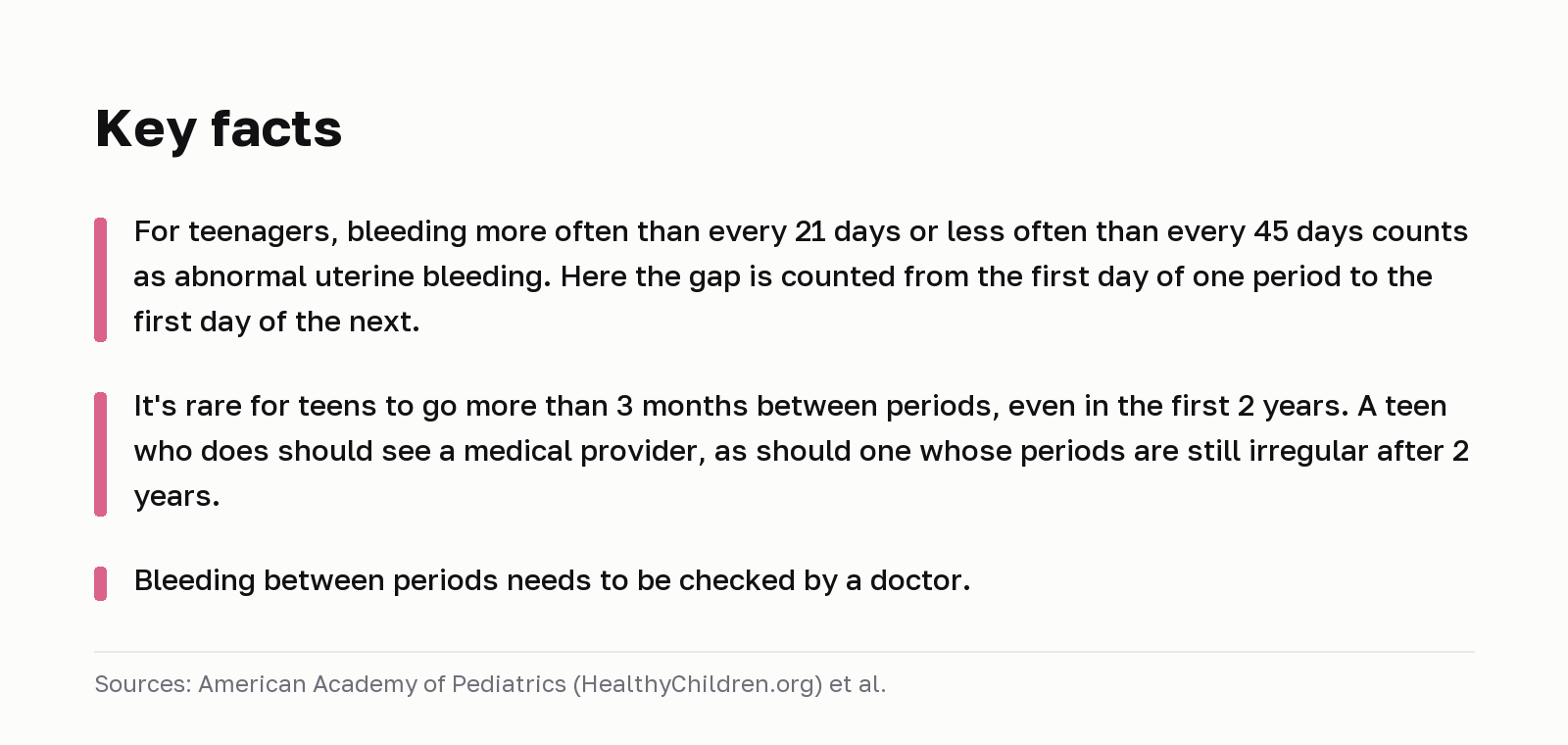
The American Academy of Pediatrics (AAP) in the United States (US) sets a wider band for teens. In its guidance for parents, bleeding more often than every 21 days or less often than every 45 days, measured from the first day of one period to the first day of the next, counts as abnormal uterine bleeding in a teenager. The adult range remains 21 to 35 days.
Irregular periods are common in the first 2 to 3 years after a first period, and most girls are having regular periods by age 16 to 18.
Even in the first 2 years, going more than 3 months between periods is rare for teens. The AAP advises seeing a medical provider if that happens or if periods are still irregular after 2 years.
Reasons to book an appointment
- Bleeding between periods needs to be checked by a doctor.
- A period that lasts more than 7 days, counting the days you bleed rather than the gap, is a sign of heavy periods and a reason to talk to a doctor.
- Your gap moves outside 21 to 35 days or your usual pattern shifts. A change in your periods doesn’t necessarily mean there’s a problem, but it does need to be looked into, which in the UK means a GP, a women’s clinic or a contraceptive clinic.
- See a GP if you’ve missed 3 periods in a row and pregnancy tests are negative.
- A teenager should see a medical provider if she goes more than 3 months between periods, or her periods are still irregular after 2 years.
Preparing for the visit
Before the appointment, write down your period dates and how heavy the flow is, for example by counting how many pads or tampons you use. You may be asked how long your cycle is. Count from day 1 so you can give a number, not a guess.

Sources
- American Academy of Pediatrics (HealthyChildren.org). Menstrual Disorders in Teens: Causes, Diagnosis & Treatment: HealthyChildren.org
- BMC women's health. Menstrual vulnerability to acute systemic stress: evidence from 884 women after COVID-19 infection
- Centers for Disease Control and Prevention. About Heavy Menstrual Bleeding: Bleeding Disorders in Women: CDC
- Cureus. Effect of COVID-19 Vaccination on the Menstrual Cycle Among Women in Dubai
- National Health Service (United Kingdom). Heavy periods: NHS
- National Health Service (United Kingdom). Irregular periods: NHS
- National Health Service (United Kingdom). Periods and fertility in the menstrual cycle: NHS
- National Health Service (United Kingdom). Periods: NHS
- npj women's health. Decoding menstrual health across the lifespan: a scoping review of digital health tools in research


Download the app and get 7 days free use


