 eng
 rus
 deu
 spa
 fra
 ita
 por
 srp
 tur
 ukr
 por
 bos
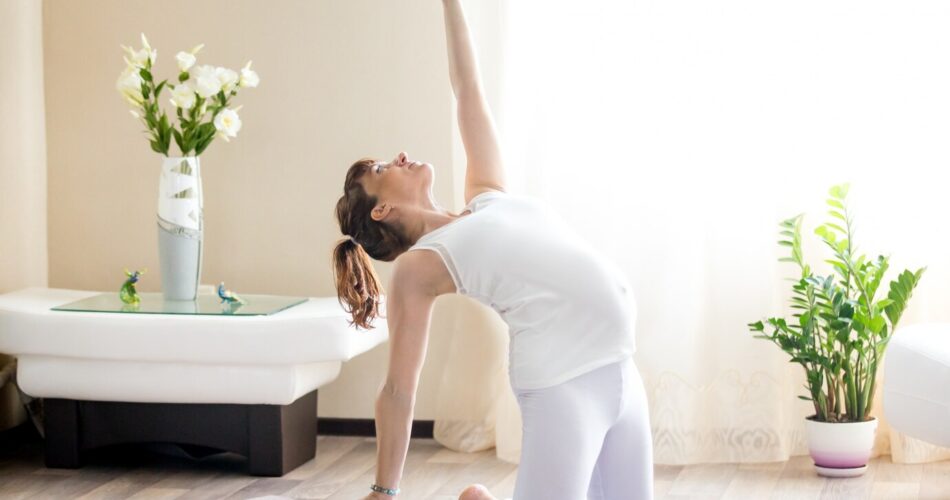
Experience with yoga can help you recognise familiar movements, but it does not make every complex pose appropriate throughout pregnancy. The useful skill is knowing when to change the practice, including leaving out a pose you previously enjoyed.
You do not need to preserve your deepest backbend, widest stretch or longest balance to remain an experienced practitioner.
Reassess the movement, not your identity
Tell your teacher about the pregnancy and any advice from your maternity team. Describe what you currently practise rather than simply saying that you are advanced.
A demanding sequence may combine balance, sustained effort, deep range of movement and quick transitions. Ask which parts can be adapted and which should be set aside.
Yoga Scotland and YogaBirth guidance recommends modifying or stopping positions that cause discomfort and avoiding strenuous fast-flowing practice or breath retention in pregnancy. Past familiarity does not remove the need for this review.
Check the risk of losing balance
NHS guidance advises avoiding activities with a risk of falling. That matters when a complex pose depends on an unsupported balance or a difficult entry and exit.
A wall or stable chair may help with a suitable variation, but support does not automatically make every inversion or balance safe. Ask a pregnancy-trained instructor to assess the whole movement.
Do not learn a new headstand or other fall-prone pose from written instructions during pregnancy. Watching a confident demonstration does not show whether you can recover safely if balance changes.
Reduce depth before forcing a stretch
A standing position may need a shorter stance or less bending. A seated stretch may need cushions, a different leg position or replacement with another movement.
Do not use your hands or elbows to push the knees down or chase a previous range. Pain is a reason to stop and reassess, not a target to work beyond.


- Pelvic floor
- Flat stomach
- Healthy back
- Posture and tone
- Yoga and Pilates
- Personalized menu
- Macronutrients and eating habits
- Meditations and podcasts
The British Wheel of Yoga describes personal practice as a balance of different kinds of movement. Difficulty alone does not determine whether a sequence suits your needs.
Yoga for the legs and glutes distinguishes strengthening from stretching.
Review positions on the floor
A position that was comfortable earlier can become awkward as the bump grows. NHS advice is to avoid spending more than a few minutes flat on your back later in pregnancy.
Ask for a side-lying or otherwise supported alternative. Do not wait for dizziness before considering a change.
Reclining yoga positions in pregnancy need their own adaptations, including how to get down and stand up comfortably.
Keep breathing and take breaks
Notice whether a position makes you hold your breath or bear down to maintain it. Reduce the effort and return to ordinary breathing rather than trying to complete a prescribed hold.
Keep cool, have water available and stop if you feel unwell. Rest can be part of the session instead of something earned by finishing every pose.
Third-trimester yoga is a separate stage-specific question.
Ask for a plan you can change
Agree with the teacher which movements currently feel comfortable and how to replace them if symptoms change. Tell your maternity team about pain or other concerns that persist outside practice.
An adapted session is not a loss of skill. It is a practical response to what your body and pregnancy require now, without promises that advanced poses make birth easier or prevent complications.
Sources
- British Wheel of Yoga, Yoga Magazine. Developing a personal practice, Tori Lang, August 2025
- NHS, United Kingdom. Exercise in pregnancy
- Shrewsbury and Telford Hospital NHS Trust. Pelvic health during pregnancy and beyond
- Yoga Scotland, YogaBirth. Guidelines for teaching yoga to pregnant women


Download the app and get 7 days free use


