 eng
 rus
 deu
 spa
 fra
 ita
 por
 srp
 tur
 ukr
 por
 bos

- Day 1: your period and the follicular phase start together
- The period: what leaves the body, and for how long
- The follicular phase: building towards an egg
- Ovulation: the release, and the timing
- Why day 14 fits only one cycle length
- The luteal phase: the steadier half
- Period or pregnancy
- Your fertile window
- How long a normal cycle is
- Where the guidance disagrees
- When to talk to a doctor
- Missed periods
- Count back, not forward
- Sources
- Read next
The menstrual cycle has four phases: menstruation (your period), the follicular phase, ovulation and the luteal phase. They overlap rather than taking turns, and the reliable way to find where you are in them is to count back from your next period, because ovulation keeps a steadier distance from the period after it than from the one before.
Some sources describe three phases instead, follicular, ovulatory and luteal, each with its own hormonal and metabolic state. The biology is the same either way; the four-phase version simply gives your period a name of its own.

Day 1: your period and the follicular phase start together
A menstrual cycle is counted from the first day of your period to the day before the next period starts. That opening day of bleeding is day 1. Researchers use the same rule: day 1 is the first day of heavy flow, and it belongs to the follicular phase.
That second half of the rule is the detail most diagrams hide. They draw four tidy slices, period first and follicular phase after it, so it comes as a surprise that the two begin together. The follicular phase starts on the first day of your period and runs alongside it, typically lasting 13-14 days in all, longer in a long cycle and shorter in a short one. While you are still bleeding, you are already in the phase that leads to the next egg.

The period: what leaves the body, and for how long
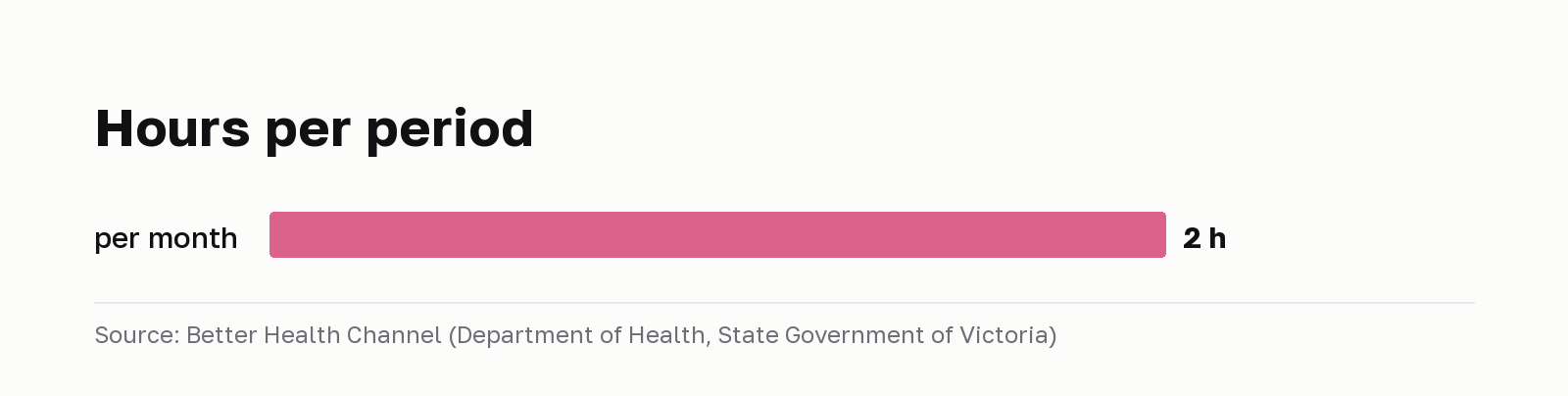
During your period, the lining of the uterus sheds and flows out of the vagina, carrying blood, mucus and some cells from that lining. A period can last 2-7 days but usually lasts about 5, and bleeding tends to be heaviest in the first 2 days. The American College of Obstetricians and Gynecologists (ACOG), the US professional body for obstetricians, says a normal period generally lasts up to 8 days, so 8 is the number to keep in mind if yours runs long.
Over a typical period you lose about 20-90 ml of blood, roughly 1-5 tablespoons, though some women bleed more heavily than that.

The follicular phase: building towards an egg
Hormones run the cycle. In a typical naturally cycling woman, oestrogen and progesterone are both low early in the follicular phase; oestrogen climbs late in it and around ovulation; and in the luteal phase progesterone is high while oestrogen sits at a moderate level.
Through the follicular phase, those shifting levels make the uterine lining thicken and follicles grow on the surface of the ovaries, and usually only one follicle matures into an egg. Rising oestrogen is what drives the ovary to develop and release that egg, and it also starts the womb lining building up.
Ovulation: the release, and the timing
Ovulation is when a mature egg is released from an ovary, and it usually happens once a month, about 2 weeks before your next period. One egg usually develops and is released each cycle; occasionally more than one is, and if more than one is fertilised, the result can be twins. Around this time, vaginal secretions typically become thinner and stretchy, a bit like raw egg white, and any change in discharge that worries you is a reason to see a doctor.

Why day 14 fits only one cycle length
Day 14 is the number most people learn first, and it is true of exactly one cycle length. Ovulation is hard to pinpoint, but in most women it happens around 10-16 days before the next period, which means only women with a regular 28-day cycle are likely to be fertile around day 14. For example, if your cycle runs a week longer than 28 days, counting back from the next period puts ovulation roughly a week later than day 14.
The luteal phase: the steadier half
After ovulation, the egg travels through the fallopian tubes to the uterus, and the uterine lining keeps thickening in preparation for pregnancy. In this second half of the cycle, the hormone progesterone helps the womb prepare for a developing embryo to implant. The time from the egg’s release to the start of the next period is around 10-16 days, and that is the stretch worth counting with.
Metabolism shifts across the cycle in small-to-moderate but consistent ways: on average, in the mid-luteal phase there is a tendency to eat more and to burn more fat than early in the follicular phase or around ovulation, though the studies behind this are mostly small and none of it is a rule for any one person.


- Pelvic floor
- Flat stomach
- Healthy back
- Posture and tone
- Yoga and Pilates
- Personalized menu
- Macronutrients and eating habits
- Meditations and podcasts
Period or pregnancy
If you get pregnant, no period comes; if you don’t, a period arrives and the cycle starts again. That period is the hormones stepping down: when pregnancy does not happen, oestrogen and progesterone levels fall, and the womb lining comes away and leaves the body.
Your fertile window
Your fertile time sits around ovulation, about 12-16 days before the start of your next period, though it is difficult to work out exactly. The window also reaches back several days before ovulation, because sperm can survive inside the body for up to 7 days, which is the upper limit rather than the usual. So it is possible, though not very likely, to get pregnant soon after your period finishes if you ovulate early or have a short cycle.
The reverse also holds: you cannot get pregnant if you do not ovulate, and some hormonal contraceptives, such as the combined pill, the patch and the injection, work by stopping ovulation. Counting days alone, then, is not a reliable way to avoid pregnancy.
If you are trying to conceive, the MomsLab cycle calendar shows your phases with a period and fertile-window forecast built from what you log, and the forecast gets sharper the longer you keep it.
How long a normal cycle is
The average cycle is about 28 days, but that is a population average rather than a target for yours. In research on healthy women of reproductive age the average comes out nearer 29 days, usually somewhere between 21 and 38, and length varies both between women and from one cycle to the next in the same woman.
Where the guidance disagrees
The edges of normal depend on whose guidance you read. According to the NHS, the UK’s National Health Service, regular cycles anywhere from 21 to 35 days long are normal. ACOG puts typical cycle length at 24 to 38 days in the years before perimenopause. Victoria’s state health department in Australia says people in their 20s and 30s may have cycles of 21 to 38 days, and teenagers cycles as long as 45 days, as examples by age rather than cut-offs.
Rather than picking one range to measure yourself against, watch your own pattern: a change in it, or any of the signs below, is what should send you to a doctor.
When to talk to a doctor
Each of these is a prompt to talk to a doctor, not a diagnosis: your period pattern changes; your periods get heavier, so you need to change a pad or tampon more often than every 2 hours; they last more than 8 days; they come less than 21 days apart or more than 2 to 3 months apart; they are painful enough to affect your life; or you bleed between periods or after sex.
Bleeding between periods or after sex needs to be checked by a doctor, because it can come from an infection or changes in the cervix and, rarely, from cancer, though most causes are not cancer.
Missed periods
If you have had sex, a missed period could mean pregnancy, so start with a test; if you have missed 3 periods in a row and the test is negative, see a doctor. This matters beyond fertility: a regular cycle is seen as a marker of overall health, and missing periods, known as amenorrhoea, has been linked, mostly in research on athletes, to poorer bone health and other adverse outcomes.
Polycystic ovary syndrome, a hormonal condition with higher than normal androgen levels, is the most common cause of not ovulating worldwide and a leading cause of irregular periods, affecting an estimated 10-13% of women of reproductive age globally, up to 70% of them undiagnosed.
Count back, not forward
The useful numbers are not 14 and 28. They are your own cycle length, noted over a few months, and the date your next period is due. Count back from that date and the phases stop being a diagram and become days on your own calendar.
Sources
- American College of Obstetricians and Gynecologists. Perimenopausal Bleeding and Bleeding After Menopause: ACOG
- Better Health Channel (Department of Health, State Government of Victoria). The menstrual cycle: Better Health Channel
- National Health Service (United Kingdom). Periods and fertility in the menstrual cycle: NHS
- National Health Service (United Kingdom). Periods: NHS
- Nutrients. An Overview of the Impact of the Menstrual Cycle on Nutrient Metabolism: An Integrative Perspective
- Sports medicine (Auckland, N.Z.). An Overarching Conceptual Framework for Menstrual Health in Sport Research: Theory, Causality and Validation
- World Health Organization. Polycystic ovary syndrome


Download the app and get 7 days free use


