 eng
 rus
 deu
 spa
 fra
 ita
 por
 srp
 tur
 ukr
 por
 bos

- How to describe the bleeding
- When to call, and how fast
- Emergency: call now
- Urgent: don’t wait for your next appointment
- Who to call
- What can cause it
- If it might be miscarriage
- When an ectopic pregnancy is possible
- Pain and other signs
- If you have had one before
- Checks and treatment
- Sources
- Read next
Brown discharge during pregnancy counts as bleeding, and that changes how you should treat it. Vaginal bleeding in pregnancy is relatively common and not necessarily a sign of anything serious, but it is a reason to get medical advice every time it happens. Brown feels reassuring, as if it were something less than blood, and that feeling is the one worth overriding: what comes with the brown, not the colour itself, decides how fast you call.

How to describe the bleeding
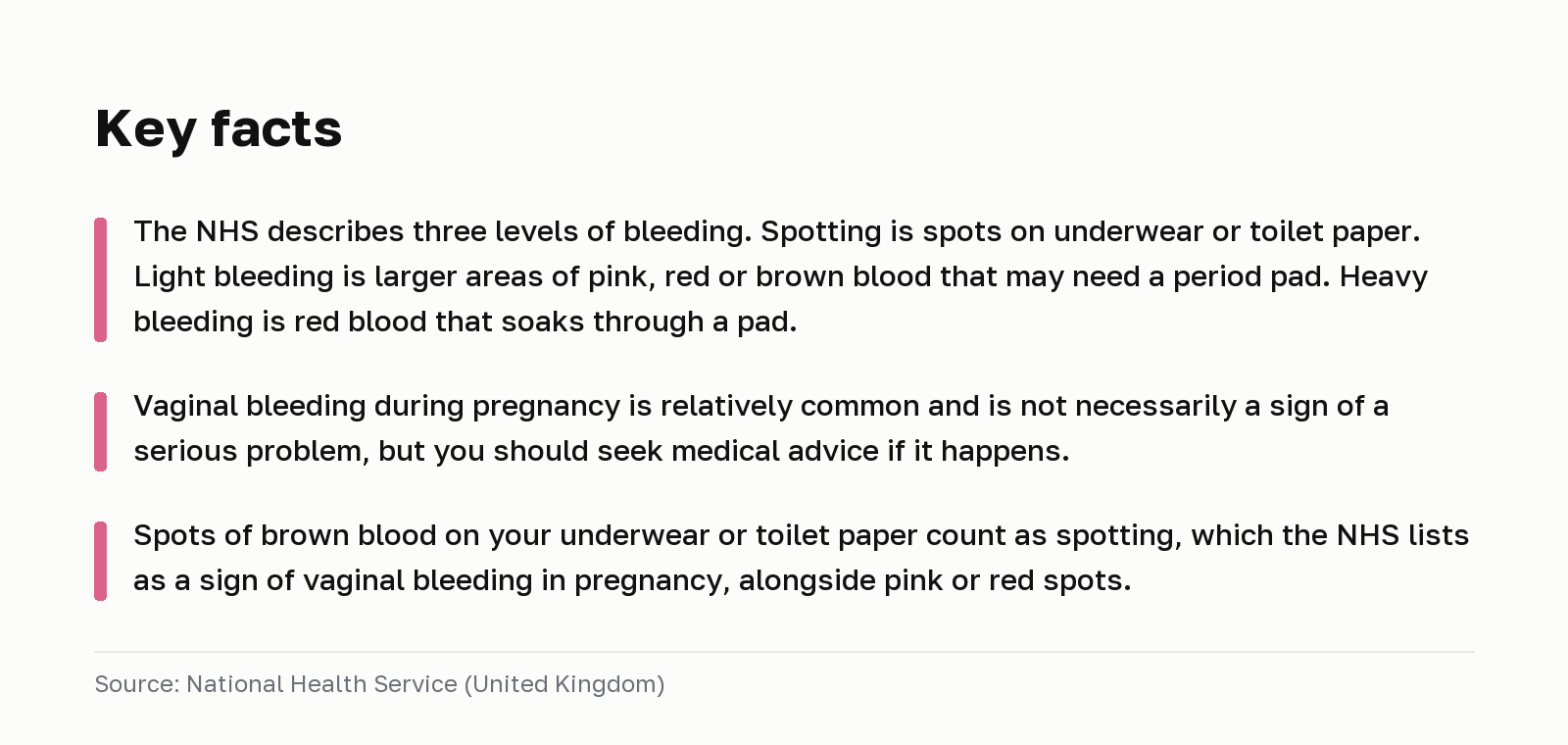
In the United Kingdom (UK), the National Health Service (NHS) describes pink, red or brown spots on underwear or toilet paper as spotting, a form of vaginal bleeding that is not necessarily serious. Light bleeding means larger patches of these colours that may need a period pad, while heavy bleeding is red blood that soaks through one. Any of it can be steady or come and go. Heavy bleeding may include clots or lumps.

When to call, and how fast
Brown spotting on its own belongs in the urgent tier, not the emergency one. Other symptoms can change that.
Emergency: call now
In the UK, call 999 if you are pregnant and bleeding, brown spotting included, and have any of these:
- severe tummy pain that stops you doing daily tasks or focusing on television (TV) or a book
- pain in your shoulder
- feeling sick, faint or dizzy, or losing consciousness
- heavy bleeding that soaks a period pad soon after you put it on.
Call 999 or go to your nearest accident and emergency (A&E) department straight away if you have a combination of sharp, sudden and intense tummy pain, feeling very dizzy or fainting, feeling sick or looking very pale, as these can be signs of a ruptured ectopic pregnancy needing surgery as soon as possible.
In the United States (US), the Centers for Disease Control and Prevention (CDC) says to seek medical care immediately for vaginal bleeding that is more than spotting, like a period, for fluid leaking from the vagina, or for vaginal discharge that smells bad.
Urgent: don’t wait for your next appointment
The NHS says to get urgent help during pregnancy for any of these:
- spotting or light bleeding with no tummy pain, or only mild pain that does not stop you doing daily tasks
- spotting or light bleeding with diarrhoea, or pain or pressure when you pee or poo
- discharge that is unusual for you, or fluid leaking from your vagina, at any stage of pregnancy.
The CDC’s immediate list starts above spotting, while the NHS includes it. For brown spots, follow the stricter NHS guidance: it is the only one of the two that covers them.
Who to call
Check the emergency signs first. For urgent help in the UK, call your maternity unit if you have its number (before 20 weeks, an early pregnancy unit may be able to help), or call NHS 111 if you do not yet have a maternity unit or cannot reach an early pregnancy unit.
Tell a healthcare professional about any bleeding in pregnancy, including spotting: it can sometimes need urgent treatment, even though bleeding and tummy pain are not always serious and can have causes other than miscarriage. In the UK, being worried is enough reason to call your maternity unit or NHS 111.
Outside the UK and US, services differ, so contact your own healthcare provider about these signs. If something feels wrong or you’re unsure whether it’s serious, the CDC advises talking to them and saying you’re pregnant.
Before calling, note how much blood there is (spots on paper, a patch that needs a pad, or soaking), whether it comes and goes, and whether you have pain anywhere, including your shoulder.


- Yoga for each trimester
- Breathing during labor
- Meditations and relaxation techniques
- Video lectures on childbirth preparation
- Nutrition program
- Consultations with experts
- Helpful articles and books
- Psychological support
What can cause it
Sometimes no cause is found. The NHS lists possibilities, not odds: implantation bleeding in very early pregnancy (when the egg implants into the womb) and changes to the blood vessels in the cervix (which can cause bleeding after sex). Other possible causes include a leak of blood from inside the womb, an infection such as a urine infection or a sexually transmitted infection, miscarriage, ectopic pregnancy, molar pregnancy and problems with the placenta such as placenta praevia.
A show happens when the plug of mucus sealing the opening of the cervix comes away, sometimes with blood, and can mean labour is starting.
If it might be miscarriage
Before 24 weeks, the main symptom of miscarriage is usually vaginal bleeding, which may come with pain and cramping in the lower tummy, pink, grey or white lumps coming from the vagina, or fluid suddenly coming out.
When an ectopic pregnancy is possible
In an ectopic pregnancy, symptoms usually appear between weeks 4 and 12. The bleeding can look unlike a period: it often starts and stops and may be watery and dark brown, though this discharge alone does not mean the pregnancy is ectopic. Some women have no symptoms at first.
In the UK, around 1 in 90 pregnancies is ectopic, about 11,000 a year. Some women mistake ectopic bleeding for a normal period and do not realise they are pregnant.
Pain and other signs
Ectopic pregnancy most often shows up as a missed period, vaginal bleeding and tummy pain together. If you are of childbearing age and have tummy or pelvic pain, ask a doctor to check you for an ectopic pregnancy, especially if you also have bleeding or a positive pregnancy test.
Possible ectopic symptoms include tummy pain low down on one side, pain in the tip of the shoulder and discomfort when peeing or pooing, all of which can have other causes, such as a stomach bug. If you might be pregnant and have a combination of these, the NHS says to contact your family doctor (GP) or call NHS 111, even without a positive test.
Shoulder tip pain, felt where the shoulder ends and the arm begins, can be a sign of an ectopic pregnancy causing internal bleeding, so get medical advice right away if you have it. If it comes with any bleeding, brown included, get emergency help.
If you have had one before
After a previous ectopic pregnancy, the risk of another is around 1 in 10. Tell your GP as soon as possible when you’re pregnant again so early scans can be carried out.
Checks and treatment
At a UK hospital or early pregnancy unit, staff will ask about your health, symptoms and how many weeks pregnant you are, and possibly about earlier bleeding or pregnancies. They may check inside the vagina, do an ultrasound scan on your tummy or inside your vagina, and test blood and urine.

Treatment depends on the cause and may depend on how many weeks pregnant you are. If tests show the bleeding is not serious and the pregnancy is healthy, you may need no treatment, though you may be offered closer monitoring, which can mean a stay in hospital. Take your maternity notes if you have them.
Whatever the cause turns out to be, the starting point stays the same: brown discharge during pregnancy counts as bleeding, and the colour is no reason to wait. It is often not serious, but it always warrants advice. Check the emergency signs first. Severe tummy pain, shoulder tip pain, feeling sick, faint or dizzy, or bleeding that soaks a pad means calling 999 now. Without them, brown spotting still means getting urgent help rather than waiting for your next appointment: call your maternity unit, an early pregnancy unit or NHS 111, or your own healthcare provider outside the UK. Being worried is reason enough to call.
Sources
- Centers for Disease Control and Prevention. Urgent Maternal Warning Signs and Symptoms: HEAR HER Campaign: CDC
- Clinical case reports. Advanced Ruptured Ovarian Ectopic Pregnancy at 19 Weeks' Gestation Presenting With Massive Hemoperitoneum: A Case Report
- National Health Service (United Kingdom). Ectopic pregnancy: NHS
- National Health Service (United Kingdom). Ectopic pregnancy: Symptoms: NHS
- National Health Service (United Kingdom). Miscarriage: NHS
- National Health Service (United Kingdom). Vaginal bleeding in pregnancy: NHS


Download the app and get 7 days free use


