 eng
eng rus
rus deu
deu spa
spa fra
fra ita
ita por
por srp
srp tur
tur ukr
ukr por
por bos
bos
- Women’s Health 40+: What age-related changes affect the body and workouts
- Anti-aging through exercise: what exactly slows down aging
- Main rules for exercising after 40: regularity, gradualness, moderate load
- Strength Training After 40: Sarcopenia, Muscle Loss, and a “Back Brace”
- Yoga after 40: body flexibility, joints, stress, and sleep quality
- Pilates after 40: posture, spine, core muscles, pelvic floor
- Balance and coordination: why they are markers of a stable body and how to train them
- Bone density and osteoporosis prevention: where yoga and Pilates are enough, and where additional loading is needed
- Weight Loss After 40: Nutrition, Metabolism, and Reducing Belly Fat
- Workout Program 40+: Weekly Example and Safety Guidelines
After 40 years, women often notice that their bodies respond differently to stress: fatigue appears more quickly, tension in the back lasts longer, and it’s harder to maintain tone and energy throughout the day. These processes are natural, but lifestyle significantly influences how pronounced they will be.
Yoga and Pilates are seen as forms of physical activity that help maintain muscles, posture, joint health, and overall well-being without excessive strain. It is important to understand which effects of these workouts are truly backed, how they impact women’s health 40+, and how to design a workout program that ensures movement contributes to long-term preservation of strength, flexibility, and quality of life.
Women’s Health 40+: What age-related changes affect the body and workouts
After the age of 40, the hormonal balance in women’s bodies gradually changes. The decrease in estrogen affects muscle tissue, bone density, and the body’s response to exertion. Recovery after workouts may take longer than before, and the feeling of fatigue may appear more quickly even with moderate physical activity for those over 40.
Metabolism changes as well. After 40, metabolism becomes less flexible: insulin sensitivity may decrease, and the propensity to accumulate fat tissue increases, especially in the abdominal area. This does not mean that losing weight is impossible, but it requires a revision of the training and nutrition program.
Chronic stress plays an additional role. Increased cortisol and stress directly affect the quality of sleep and the body’s ability to adapt to exertion. If sleep is disturbed, muscles recover less effectively, and workouts yield less effect.
These age-related changes are not obstacles to movement. On the contrary, properly selected exercise helps maintain health, metabolism, and body functionality. It is only important to consider recovery characteristics and build a training program with regard to hormonal balance and current energy levels.
Anti-aging through exercise: what exactly slows down aging
Slowing down aging in the context of physical activity is related to specific physiological mechanisms. Regular exercise maintains muscle mass and strength, which directly influences energy levels, endurance, and independence retention as we age. Muscles are one of the main regulators of metabolism, and their activity helps maintain a stable metabolism after the age of 40.
The second important mechanism is maintaining joint mobility and stability. Working on joint mobility, balance, and coordination reduces the risk of injuries and falls, improves movement control, and supports musculoskeletal health. This directly impacts quality of life and the ability to stay active without pain.
The third factor is neuromuscular control. Regular training improves the connection between the nervous system and muscles, supporting posture and core stability. Good body control reduces excess stress on the back and joints, helping to maintain the functional ‘youth’ of movement for longer.
These mechanisms (strength, stability, mobility, and regular load) form the basis of anti-aging through movement. It involves systematic work with the body that supports health and functionality in the long term.
Main rules for exercising after 40: regularity, gradualness, moderate load
After 40, results depend not on extreme intensity but on a well-structured routine. To make workouts effective and prevent injuries, it’s important to follow some basic principles:
- Regular workouts are more important than occasional overloads. The body adapts to stress through repetition. The optimal routine is 3–4 workouts a week for 30–50 minutes. Consistency in exercising helps maintain muscles and endurance without sudden spikes of stress. When sessions are regular, metabolism and recovery processes are more stable than with sporadic efforts.
- Moderate load instead of “working to exhaustion.” A workout program for 40+ should be based around moderate intensity. During the session, breathing control is maintained, exercise technique does not suffer, and the next day there is no feeling of complete exhaustion. Such a load stimulates muscles and supports health without overloading joints and the nervous system.
- Gradual load and thoughtful progression. The complexity of exercises should increase gradually. First, the technique is mastered, then time under load, amplitude, or stability is added. A sharp increase in intensity after a break often leads to back pain or overstrain. Safe workouts are built on the principle of sequential complication, not sudden leaps.
- Balanced exercise regimen. The program should include a set of exercises for the main muscle groups: core work, balance, and strength elements. Focusing solely on cardio or just stretching does not yield a sustainable result. A comprehensive approach allows for even distribution of the load and maintains the body’s functionality.
- Recovery after exertion is part of the workout. Post-exercise, the body needs time for adaptation. Quality sleep, active rest days, and adequate nutrition help muscles recover. Ignoring recovery after exertion, regular workouts can lead to chronic fatigue and decreased efficiency.
This structure will allow for gradual strengthening of the body and maintenance of health without overload.
Strength Training After 40: Sarcopenia, Muscle Loss, and a “Back Brace”
After the age of 40, gradual sarcopenia begins, which is the age-related loss of muscle mass and strength. This process may be subtle, but it significantly impacts the decrease in endurance, changes in body shape, and reduction in overall body tone. If muscles do not receive regular exercise, their volume and functionality gradually decrease.
Strength training after 40 is a key tool for preventing sarcopenia. Strength exercises stimulate muscle fibers, support bone density, and help maintain a stable metabolism. Muscles are an active metabolic tissue, and their activity is directly linked to how the body uses energy. Therefore, strength training is important not only for appearance but also for maintaining health in the long term.
Particular importance is given to working with the core. Core muscles form a natural “corset” for the back, support the spine, and reduce excessive strain on the lower back. A weak core often leads to chronic back discomfort. Strengthening the deep abdominal muscles helps stabilize the core, improve posture, and distribute load more evenly.
Strength training doesn’t necessarily require complex equipment. Bodyweight exercises like squats, lunges, push-ups, and various plank variations effectively engage major muscle groups. Equipment-free workouts can be conveniently performed at home, gradually increasing the challenge by adjusting the time under tension or changing body positions.
Regular strength work supports muscles, improves posture, and reduces the risk of back pain. Combined with moderate overall exertion, it creates a sustainable foundation for health, helping the body maintain strength and stability after 40 years.
Yoga after 40: body flexibility, joints, stress, and sleep quality
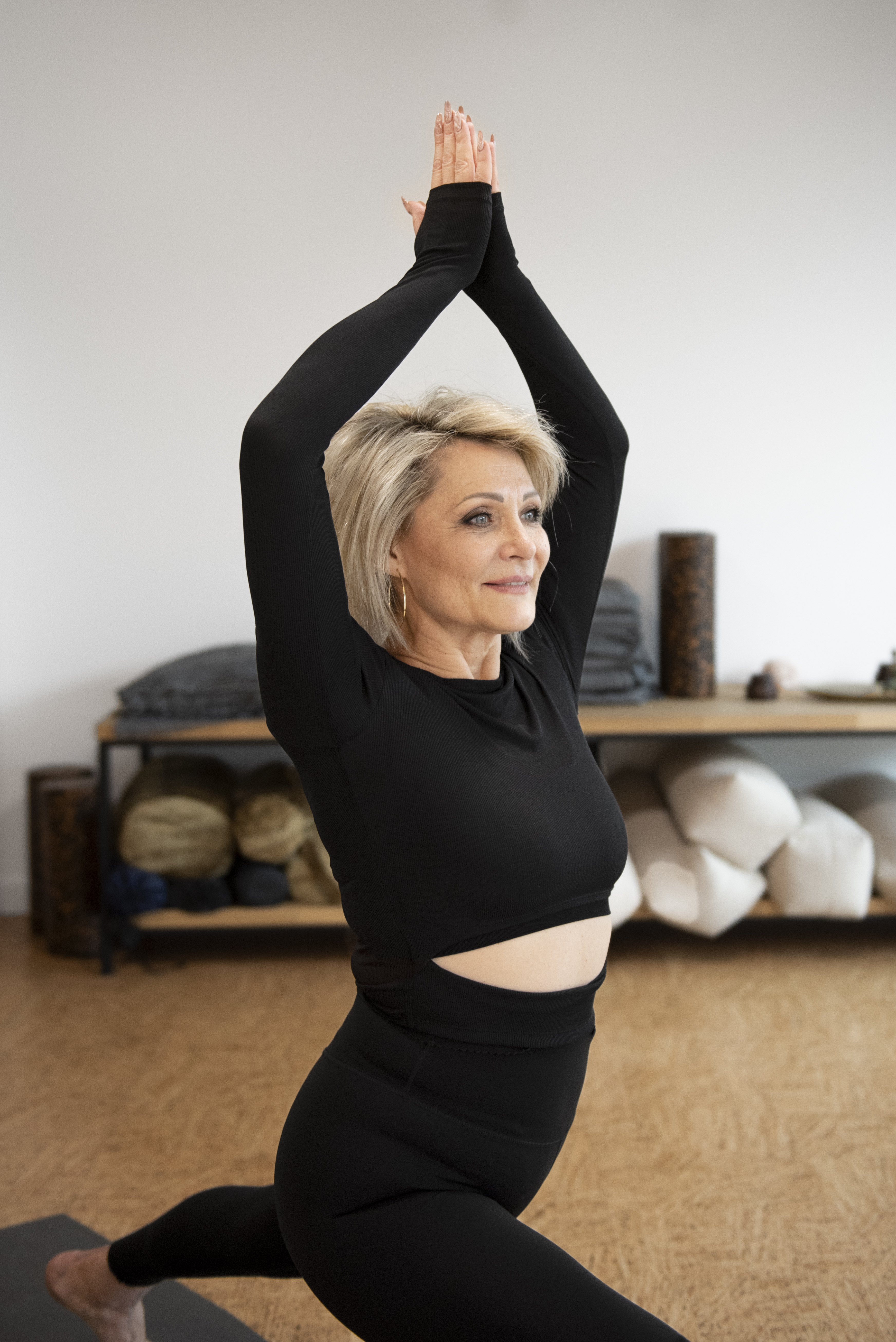
Yoga after 40 primarily focuses on mobility and movement control. With age, the range of motion in the joints gradually decreases, ligaments become less elastic, and muscles lose some of their firmness. Regular yoga helps maintain body flexibility and joint mobility without sudden jerks and overload. Smooth movements and holding poses gently increase the range and keep the joints working comfortably.
For women over 40, safety is particularly important. Yoga for women 40+ is based on breath control and attention to sensations. The practice does not require high speed or extreme stretching. A 30–40 minute yoga mat session can already support spinal mobility, reduce back stiffness, and improve posture.
A separate effect is related to the nervous system. Chronic stress and increased cortisol and stress directly affect well-being, energy levels, and sleep. Breathing practices and a slow rhythm of movements help reduce internal tension by activating relaxation mechanisms. As a result, sleep quality improves, and recovery after a stressful day becomes easier.
Yoga does not replace strength training but complements it. It supports flexibility, balance, and stability, helps the body recover faster, and reduces the impact of stress. For women over 40, it’s a way to maintain mobility, reduce muscle tension, and support overall well-being without excessive load.
Pilates after 40: posture, spine, core muscles, pelvic floor
Pilates after 40 is a system focused on the quality of movement. The foundation of the method lies in body position control, core stability, and working with deep muscles. This approach is particularly important for women who experience back discomfort or posture deterioration with age.
The main area of focus is the core muscles. The core includes deep abdominal muscles, back muscles, and pelvic floor structures. These provide internal support for the spine. When these muscles are weakened, the load is redistributed to the lower back and cervical spine, which over time can lead to back pain and a feeling of instability. Regular Pilates strengthens the core, improves posture, and reduces excessive tension.


- Helpful articles and checklists
- Podcasts and lectures with specialists
- Meditations and relaxation
- Expert answers 24/7
- Women's community
- Convenient notifications
- Meal plans and recipes
- Workouts at a convenient time
The pelvic floor holds special significance. After 40, and especially after childbirth, supporting the pelvic floor becomes critically important for core stability and preventing discomfort under load. In Pilates exercises, working with the pelvic floor muscles is integrated into every movement through breath control and gentle engagement of the deep abdominal muscle layers.
Pilates also enhances balance and coordination. The slow, precise exercises require constant control of body and limb positions. This reduces the risk of injury and improves the body’s ability to stabilize under everyday stress.
Most exercises can be done both in the gym and at home. Bodyweight exercises allow you to dose the load and gradually complicate the program without overloading the joints. With regular practice, Pilates becomes a tool for maintaining spinal stability, core control, and overall body balance.
Balance and coordination: why they are markers of a stable body and how to train them
With age, the ability to maintain balance gradually decreases. This is related not only to muscle strength but also to the functioning of the nervous system, joint condition, and reaction speed. Balance and coordination are indicators of how well muscles, ligaments, and the brain work together. If this system fails, the risk of falls, joint overload, and injuries increases.
Regular workouts that include stability exercises help maintain joint health and sustain confidence in movement. When the body holds its center of gravity stable, the load is distributed evenly, reducing excess pressure on the knees, ankles, and spine. This is especially important after the age of 40, when recovery from injuries takes longer.
In this regard, yoga and Pilates work systematically. Slow transitions between positions, holding poses, and working with unstable supports develop deep muscles and improve movement control. As a result, energy and endurance in daily activities are enhanced—from brisk walking to climbing stairs.
To develop balance and coordination, you can include the following in your workout program:
- single-leg exercises with control of body position;
- slow lunges with hold at the bottom point;
- planks with alternating lifting of the arm or leg;
- smooth transitions from sitting to standing without support;
- yoga elements with holding a pose for 20–40 seconds.
Regular inclusion of balance exercises makes workouts more functional. Even simple stability work — holding a pose, core control, slow transitions — reduces the risk of joint overload and falls. This directly impacts maintaining mobility and confidence in movement with age.
Bone density and osteoporosis prevention: where yoga and Pilates are enough, and where additional loading is needed
After the age of 40, the decline in estrogen levels gradually affects bone density. In women, this process is more pronounced, especially during perimenopause and after the age of 50. Loss of bone mass occurs slowly, but it is at the core of the increased risk of fractures. Therefore, osteoporosis prevention becomes part of a health preservation strategy.
Yoga and Pilates improve posture, balance, and coordination, reducing the likelihood of falls. This is an important contribution to bone protection, especially in older age. However, smooth movements and stretching alone do not create enough mechanical load on bone tissue to actively stimulate its density.
Bones respond to weight-bearing and strength-loading exercises. It is strength exercises after the age of 40—squats, lunges, bodyweight exercises or exercises with additional resistance—that create a stimulus for maintaining bone mass. Even moderate strength training after 40, performed regularly, helps maintain bone density and slows the rate of age-related changes.
It is important to consider contraindications to training. In cases of already diagnosed osteoporosis or significant reduction in bone density, programs are tailored individually. Sharp spinal twists, jumps, and impact loads are avoided. Safe workouts are based on controlled movements, gradual increase in resistance, and mandatory attention to technique.
You can gradually incorporate strength elements: 2–3 workouts a week for 30–45 minutes focusing on major muscle groups. Full recovery is necessary between sessions, as bone tissue adaptation requires time. This approach allows you to combine yoga and pilates for mobility and control with strength work to maintain bone density without overloading the body after the age of 40.
Weight Loss After 40: Nutrition, Metabolism, and Reducing Belly Fat
Weight loss after the age of 40 requires a different approach than in younger years. Metabolism becomes less flexible after 40: metabolic processes change, muscle mass decreases, and insulin sensitivity may worsen. In this context, trying to lose weight solely by increasing cardio rarely yields sustainable results.
Nutrition becomes a key part of the program. Without dietary adjustments, even regular workouts do not ensure stable weight loss. Metabolism is directly dependent on body composition: the more active muscles, the higher the energy expenditure at rest. Therefore, strength exercises and nutrition with sufficient protein work together.
Weight loss after 40 is primarily about controlling the energy balance. A moderate calorie deficit combined with strength training allows for weight reduction without significant muscle loss. On the contrary, drastic restrictions slow down metabolism and worsen well-being.
A separate area of focus is the abdominal area. Reducing belly fat after 40 is more challenging due to hormonal changes and possible insulin resistance. Increased cortisol and stress contribute to fat accumulation in the abdominal area, while chronic lack of sleep intensifies appetite. Therefore, managing stress levels and improving sleep quality directly impact the outcome.
In a program aimed at weight loss and reducing abdominal volume, it is important to consider:
- sufficient protein intake to preserve muscle and support metabolism;
- a moderate calorie deficit without strict dieting;
- strength exercises 2–3 times a week to maintain muscle mass;
- regular walking or other cardio activities to increase energy expenditure;
- stress management and sufficient sleep to normalize appetite and hormonal balance.
Losing weight after 40 is not a quick process but a systematic approach involving nutrition, exercise, and lifestyle. The combination of strength training, a well-thought-out diet, and stress control provides the most sustainable results and helps reduce belly size without extreme measures.
Workout Program 40+: Weekly Example and Safety Guidelines
A workout program for those over 40 should combine strength exercises, mobility work, and cardio. This format helps maintain muscles, joint health, and metabolism without overloading. It’s important for workouts to be regular yet moderate in intensity.
A week can be structured as follows:
- Monday — Strength training routine (30–40 minutes). Bodyweight exercises: squats, lunges, push-ups, plank, exercises for the abdomen and back. This routine targets large muscle groups and supports metabolism.
- Tuesday — Brisk walking or light cardio exercise (30–45 minutes). Brisk walking is one of the safest cardio options. It supports endurance and aids in weight loss without excessive pressure on the joints.
- Wednesday — Pilates (30–40 minutes). Focus on core muscles, body control, and back exercises. Pilates improves posture and stabilizes the spine.
- Friday — Strength exercises (30–40 minutes). Repeat the routine with gradual complexity: increase the time under tension or add more complex movement variations. Progression should occur gradually.
- Sunday — yoga (30–50 minutes). Focus on flexibility, joint mobility, and recovery post-exercise. Yoga helps relieve muscle tension and maintain balance.
When planning a program, it is important to consider contraindications for training. Restrictions may relate to joint diseases, spine, cardiovascular system, or severe osteoporosis. In such cases, the intensity is selected individually and, if necessary, coordinated with a doctor.
Thus, slowing down aging in the context of fitness is about maintaining strength, mobility, and body stability. The best result comes from a combination of strength training, cardio, yoga, and Pilates, supplemented with adequate sleep and thoughtful nutrition. Regular movement, recovery, and consistency will help maintain health and quality of life after 40 years.


Download the app and get 7 days free use


