 eng
 rus
 deu
 spa
 fra
 ita
 por
 srp
 tur
 ukr
 por
 bos
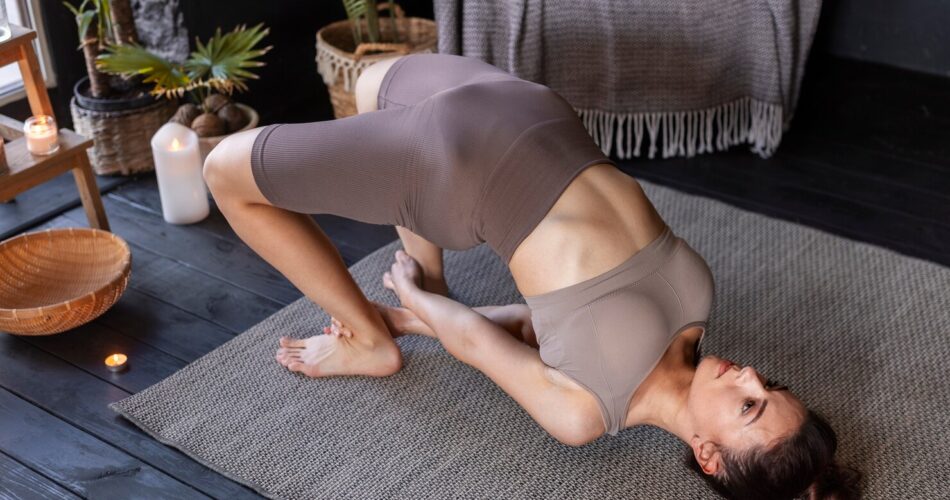
Yoga can include both strengthening work for the legs and stretches around the hips, but those are different tasks. A deeper stretch is not automatically a better exercise for your glutes, and no pose guarantees a particular change in their appearance.
Choose a practice that you can control and adapt. If you are pregnant, recovering from birth or managing pain, ask for a programme suited to that situation before copying a general sequence.
Distinguish effort from range of movement
Standing poses can ask the legs to support your weight, while seated positions may mainly explore comfortable movement at the hips. Neither has to look like a photograph to be useful.
The British Wheel of Yoga’s guidance on personal practice includes standing warrior variations alongside hip and leg stretches. It recommends a balance of strengthening and flexibility rather than collecting increasingly difficult poses.
For someone starting out, the first question is whether the movement can be performed steadily. Breath-holding, pain or losing balance are reasons to reduce the difficulty and ask for guidance.
A supported bridge is one option
A bridge appears in yoga practice and in NHS physiotherapy exercises for the gluteal muscles. For a general adult version, begin on your back with knees bent and feet resting on the floor.
Gently engage the buttocks and lift the pelvis only as far as you can control. Lower smoothly. Keep the movement comfortable rather than pushing into the largest possible backbend.
A physiotherapist can decide whether this movement suits you and how much to do. Do not progress to a single-leg version just because the two-leg version looks simple. Pregnancy and early postnatal recovery require separate adaptations.
Learn standing poses with feedback
Ask a teacher to show a suitable warrior variation and check your stance. You can discuss support, the distance between your feet and how to return to standing without losing control.


- Pelvic floor
- Flat stomach
- Healthy back
- Posture and tone
- Yoga and Pilates
- Personalized menu
- Macronutrients and eating habits
- Meditations and podcasts
There is no requirement to achieve a deep knee bend or a very wide stance at your first attempt. A teacher should be able to offer a simpler version rather than asking you to push through discomfort.
Starting Hatha yoga involves choosing a suitable class as well as learning individual movements.
Keep stretches comfortable
Hip stretches should not become a contest to reach the floor. In a seated position, use support if needed and avoid pressing the knees down with your hands.
A pulling sensation that becomes painful is a reason to ease out. If discomfort continues, stop that movement and seek advice instead of repeatedly testing it.
Do not confuse the ability to sit deeply in a pose with the strength needed for walking, lifting or other tasks.
Pregnancy and recovery change the plan
A general leg routine is not automatically a prenatal session. Yoga in early pregnancy needs an instructor who understands that stage.
After birth, hip and buttock exercises should follow your recovery and symptoms, not a promised timetable for reshaping your body.
Bring your teacher a clear goal, such as learning a stable standing pose or returning to comfortable movement. Agree on a small set of suitable exercises, then review how they feel before adding more.
Sources
- British Wheel of Yoga, Yoga Magazine. Developing a personal practice, Tori Lang, August 2025
- Cambridge University Hospitals NHS Foundation Trust. Hip strengthening exercises
- NHS. Keeping fit and healthy with a baby
- NHS, United Kingdom. Exercise in pregnancy


Download the app and get 7 days free use


