 eng
eng rus
rus deu
deu spa
spa fra
fra ita
ita por
por srp
srp tur
tur ukr
ukr por
por bos
bos
- Why the Question of Choosing a Workout Format Arises During Pregnancy
- The Benefits of Physical Activity for Pregnant Women
- Workouts in the Gym During Pregnancy
- Home Workouts During Pregnancy
- Main advantages of home workouts
- Limitations of Home Workouts
- Comparison: Gym or Home Workouts During Pregnancy
- Workouts in the First Trimester of Pregnancy
- Workouts during the second trimester of pregnancy
- Workouts in the third trimester of pregnancy
- Contraindications and Precautions
- The Role of the Doctor and an Individual Approach
- Conclusion
Compare gym and home workouts for pregnant women, find out which exercises are safe in each trimester, and get a checklist for choosing the format of classes. The article includes doctor’s recommendations and practical advice
Physical activity during pregnancy helps maintain a woman’s health, improves well-being, and prepares the body for childbirth. However, many wonder where it is better to exercise: in the gym or at home. The choice of workout format depends on the term, condition of the body, level of physical fitness, and doctor’s recommendations. This material provides a detailed analysis of both workout options, permissible loads, and key features in different pregnancy periods.
Why the Question of Choosing a Workout Format Arises During Pregnancy
During pregnancy, a woman’s body gradually changes. Weight increases, the center of gravity shifts, and there is more strain on the back, joints, and abdominal muscles. The cardiovascular system functions differently, fatigue increases, and there may be pain in the lower back and legs. During this period, physical activity should be safe, regular, and suited to the body’s capabilities.
Many women attended fitness clubs and worked out at the gym before pregnancy. Afterwards, some wonder if they can continue such activities. Others, on the contrary, consider home exercises as a calmer and more controlled option. The choice is influenced by the time available to the expectant mother, her overall health, and the results of medical check-ups.
It is important to consider that there is no one-size-fits-all solution for all pregnant women. The workout format is selected individually, taking into account the pregnancy term, the level of physical activity before conception, and possible contraindications.
The Benefits of Physical Activity for Pregnant Women
Regular exercise helps maintain muscle tone, improves circulation, and positively affects the overall condition of the body. Moderate physical activity helps reduce swelling, lessen back pain, and maintain proper posture. For many women, exercise becomes a way to improve their emotional state and reduce stress levels.
According to medical observations, physical activity during pregnancy helps prepare the body for childbirth. Women who exercised regularly often experience easier postpartum recovery. Exercises also positively affect the respiratory system, which is important during labor.
For the baby, the benefits of the mother’s physical activity include improved placenta blood supply and maintaining stable metabolism. In the absence of contraindications, such activities are considered safe and beneficial.
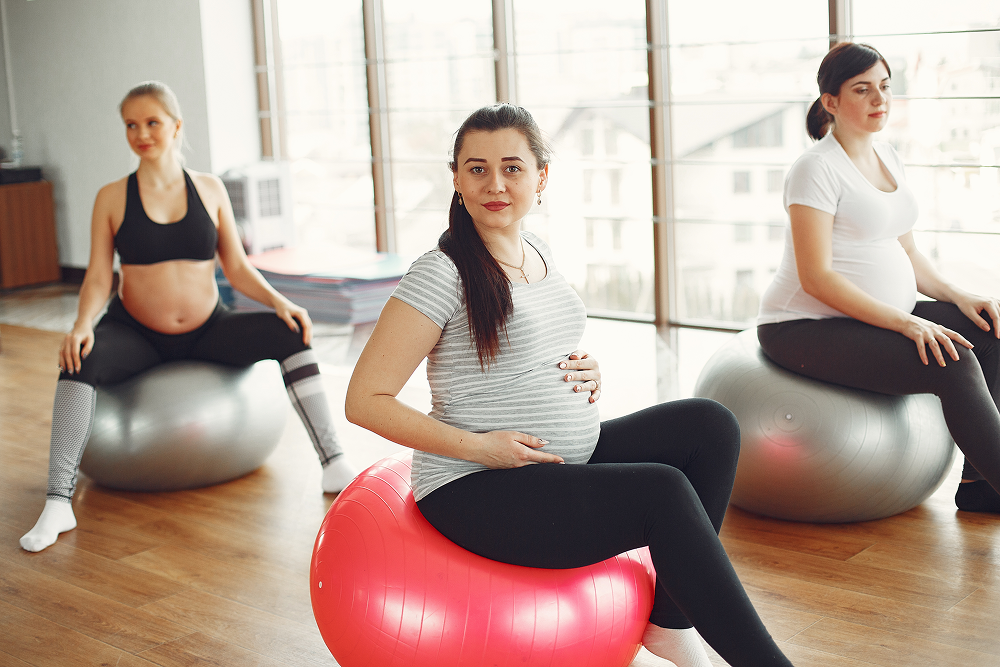
Additionally, it is important to remember that safe activity is not limited to just “gym/home.” In some cases, water aerobics is suitable: water reduces the strain on joints and the spine while providing moderate strength and aerobic loads, as well as helping to reduce the sensation of heaviness and pain in the pelvic area. Another gentle option is exercises on a fitness ball: due to support and smooth amplitude, they reduce the risk of injury and are often more comfortable in the later stages.
Workouts in the Gym During Pregnancy
Workouts in the gym are suitable for women who have previously had experience with physical activities and feel confident performing exercises. Fitness clubs offer special programs for pregnant women, designed for moderate loads and different trimesters.
The benefits of the gym include having a trainer who can monitor exercise technique and adjust the load. This is especially important when working with the muscles of the back, legs, and pelvic floor. The gym also uses a variety of equipment that allows for a uniform and safe distribution of load.
At the same time, gym sessions require consideration of additional factors. It’s necessary to adhere to a schedule, account for travel time, and consider your overall well-being on a specific day. During pregnancy, it is important for women to avoid overheating, excessive fatigue, and overly intense loads. Therefore, any gym activities should be coordinated with a doctor and adapted to the current state of the body.
Home Workouts During Pregnancy
At-home workouts are often chosen by expectant women who find it important to independently control the pace of their sessions and level of physical activity. This format is suitable when well-being is stable and there are no medical contraindications.
Main advantages of home workouts
They allow you to structure sessions considering the individual characteristics of your body and current condition. Among the main advantages of this format:
- the ability to train at convenient times without being tied to a gym schedule;
- control over the duration and frequency of weekly workouts;
- a comfortable environment that reduces stress levels;
- the option to immediately stop exercising if your well-being worsens;
- convenience for women who experience high fatigue during pregnancy.
The exercises most often performed at home are for the back muscles, legs, and pelvic floor, as well as breathing practices that help maintain overall body condition.
Limitations of Home Workouts
Despite the convenience, exercising at home requires a careful approach. Without a trainer, the risk of errors in exercise technique increases. This is especially important during pregnancy, when incorrect load distribution can lead to discomfort.
When exercising at home, consider the following:
- the necessity of prior consultation with a physician;
- use only specialized programs for pregnant women;
- avoid sudden movements and excessive tension of the abdominal muscles;
- monitor your breathing and overall well-being during the workouts.
Home exercises should be regular but moderate, with careful consideration of the body’s response. According to the recommendations of the American College of Obstetricians and Gynecologists, a minimum of 150 minutes of moderate physical activity per week is optimal. It is also worth noting that workouts can be conducted 3–4 times a week or daily for 20–30 minutes.
To keep the load adequate, it’s important to monitor intensity. A convenient guideline is the “talk test”: if during activity the pregnant woman can comfortably maintain a conversation without shortness of breath or feeling “out of air,” the pace is generally suitable. Additionally, you can monitor your heart rate: it is often advised not to exceed a range of about 140–150 beats per minute unless the doctor provides other individual instructions.
Comparison: Gym or Home Workouts During Pregnancy
The choice between gym workouts and home exercises depends on several factors. In the gym, a woman receives professional supervision, access to specialized programs and equipment. This can be beneficial for maintaining physical activity at a stable level, especially if there is experience in fitness before pregnancy.


- Yoga for each trimester
- Breathing during labor
- Meditations and relaxation techniques
- Video lectures on childbirth preparation
- Nutrition program
- Consultations with experts
- Helpful articles and books
- Psychological support
Home workouts are suitable for women who need to reduce external pressures and focus on their well-being. This format is often chosen when it’s difficult to regularly attend a gym or when a flexible schedule is required.
From a safety perspective, both options can be beneficial with the right approach. The key condition remains adherence to doctor’s recommendations, consideration of individual data, and health condition. Any exercises should avoid overloading, sudden movements, and high intensity.
Comfortable, loose-fitting clothing is important, as it doesn’t restrict movement or press on the abdomen, and sturdy sneakers (if not training barefoot on a mat), with a water bottle nearby. It’s better to train in a well-ventilated room or, if the weather and your condition allow, outdoors—this makes it easier to avoid overheating and excessive fatigue.
Workouts in the First Trimester of Pregnancy
The first trimester of pregnancy is considered the most sensitive period. During this time, the body undergoes significant restructuring, the main systems of the fetus are formed, and many women experience morning sickness, increased fatigue, and changes in well-being.
With good well-being and a doctor’s approval, the following are permissible:
- light exercises without axial loading;
- gentle stretching;
- breathing practices;
- exercises to improve circulation;
- short low-intensity workouts.
Workouts in the gym during the first trimester are possible only with the approval of a doctor and under the supervision of a specialist. Home workouts during this period are often seen as more comfortable, as they allow for consideration of how one feels on a given day. It’s important to closely monitor the body’s reaction and stop exercising if discomfort or pain occurs.
Workouts during the second trimester of pregnancy
The second trimester is often considered the most stable period of pregnancy. Many women experience improved well-being, reduced nausea, and increased energy. During this time, physical activity can be more regular, provided there are no contraindications and normal medical check-ups.
In the second trimester, workouts are aimed at maintaining the muscles of the back, legs, and pelvic floor, as well as improving the overall tone of the body. The intensity remains moderate, without sudden movements and excessive strain. These activities help control weight gain and maintain activity without risk to the fetus.
Permissible types of activities in the second trimester:
- exercises to strengthen the muscles of the back and legs;
- light fitness for pregnant women;
- breathing practices;
- stretching with controlled range of motion.
Workouts in the gym during the second trimester are possible with specialized programs and trainer supervision. Home exercises are also suitable if the woman can confidently perform exercises and monitors her well-being.
Workouts in the third trimester of pregnancy
The third trimester is characterized by increased load on the spine, joints, and abdominal muscles. During this period, physical activity is aimed at maintaining mobility, reducing back tension, and preparing the body for childbirth.
Workouts in the third trimester become less intense. The main focus is on breathing, muscle relaxation, and maintaining overall condition. The duration of sessions is reduced, and the workout load is adjusted based on the woman’s current well-being.
The most commonly used in the third trimester are:
- pelvic floor exercises;
- breathing techniques;
- gentle stretching;
- exercises for improving posture.
Home workouts during this period often prove more convenient, as they allow for flexible adjustment of the load. Gym sessions are permissible only with good wellness and constant specialist supervision.

Contraindications and Precautions
During pregnancy, there are conditions where physical activity is limited or completely restricted. It is necessary to consult a doctor before starting any exercise and to consider the individual characteristics of the body.
The main contraindications include:
- risk of miscarriage;
- cardiovascular system diseases;
- high blood pressure;
- complications;
- poor general condition of the woman.
If there is pain, dizziness, or a sudden deterioration in well-being, exercise should be stopped. It is especially important for a future mom to listen to her body’s signals and understand that during pregnancy, the body may require more rest.
If exercises are properly chosen, the body responds well to sessions, and safe exercises help maintain an active lifestyle without unnecessary risk. Workouts should be done regularly but only to the extent that you can stay active and maintain good well-being.
The Role of the Doctor and an Individual Approach
Consultation with a doctor is an essential part of planning physical activity during pregnancy. The specialist assesses the body’s condition, test results, and term, after which they can recommend permissible types of exercises and levels of intensity.
An individual approach allows for the selection of a suitable format of exercises, whether it’s a gym or home workouts, and adapts the program to a specific period.
Conclusion
Choosing between gym workouts and home exercises depends on a woman’s condition, pregnancy term, fitness level, and doctor’s recommendations. Both options can be beneficial if safety rules are followed and intensity is moderate. The main focus should be on well-being, exercise regularity, and consideration of the body’s individual features. If you want to follow a clear program with gentle loads and support, check out suitable workouts for pregnant women in MomsLab.


Download the app and get 7 days free use


